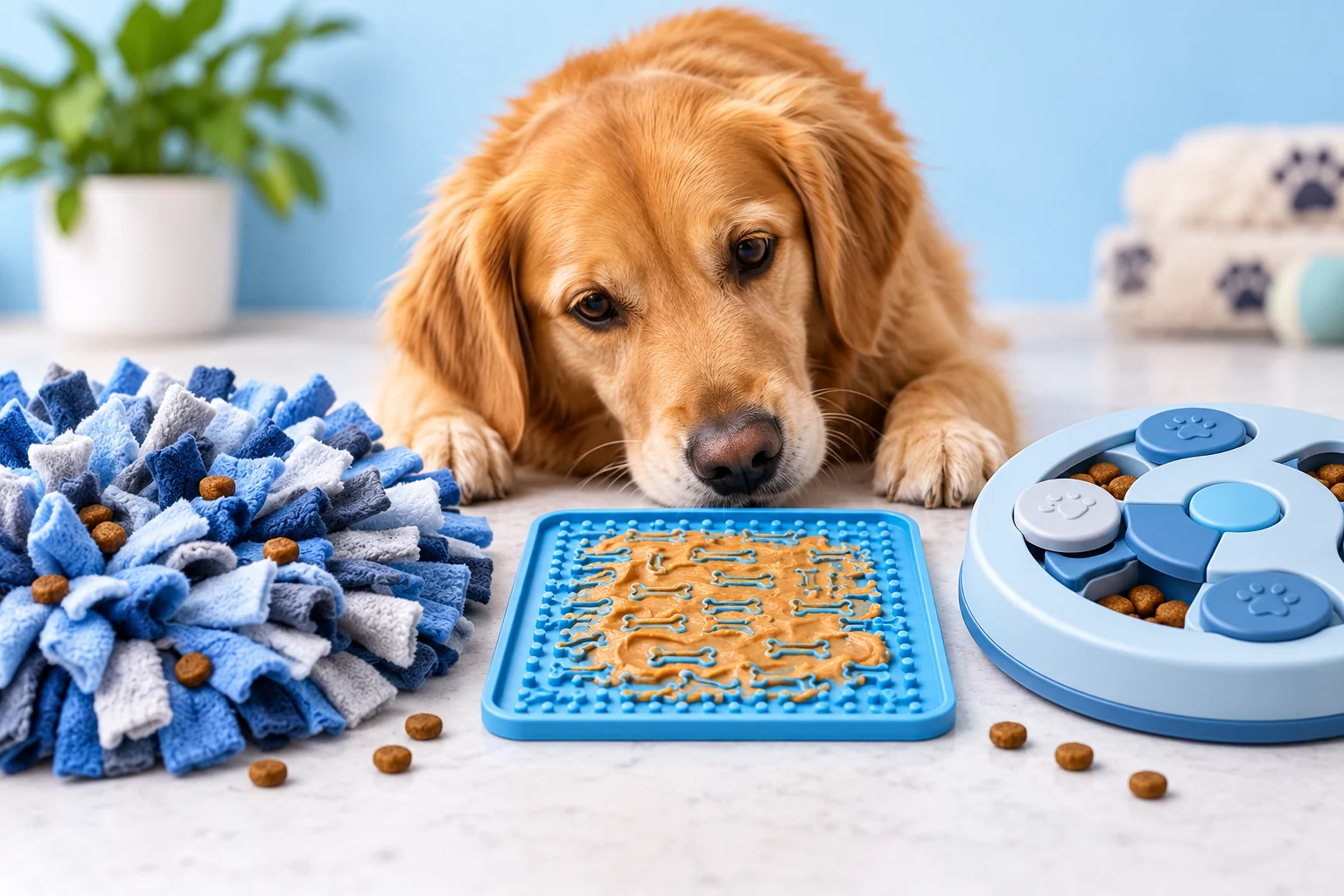
Some dogs eat dinner. Others make it vanish.
You set the bowl down, turn around to rinse the scoop, and by the time you look back, there’s a gleaming, licked-clean bowl and a dog staring at you like you forgot to feed them.
Five seconds. Maybe four.
If this sounds familiar, you might have considered buying a snuffle mat, lick mat, or puzzle feeder. These popular dog enrichment toys can turn an ordinary meal into something a little more interesting.
But which one is actually worth buying?
Here’s the thing: snuffle mats, lick mats, and puzzle feeders do different jobs. One encourages sniffing, another keeps your dog’s tongue busy, and the third challenges them to figure things out.
The best choice isn’t necessarily the fanciest or most expensive. It’s the one that matches your dog’s personality, eating habits, and enthusiasm for turning household objects into confetti.
Let’s figure out which one deserves a spot in your dog’s toy collection.
Snuffle Mat vs. Lick Mat vs. Puzzle Feeder: Quick Comparison
Short on time? Here’s how the three enrichment toys stack up.
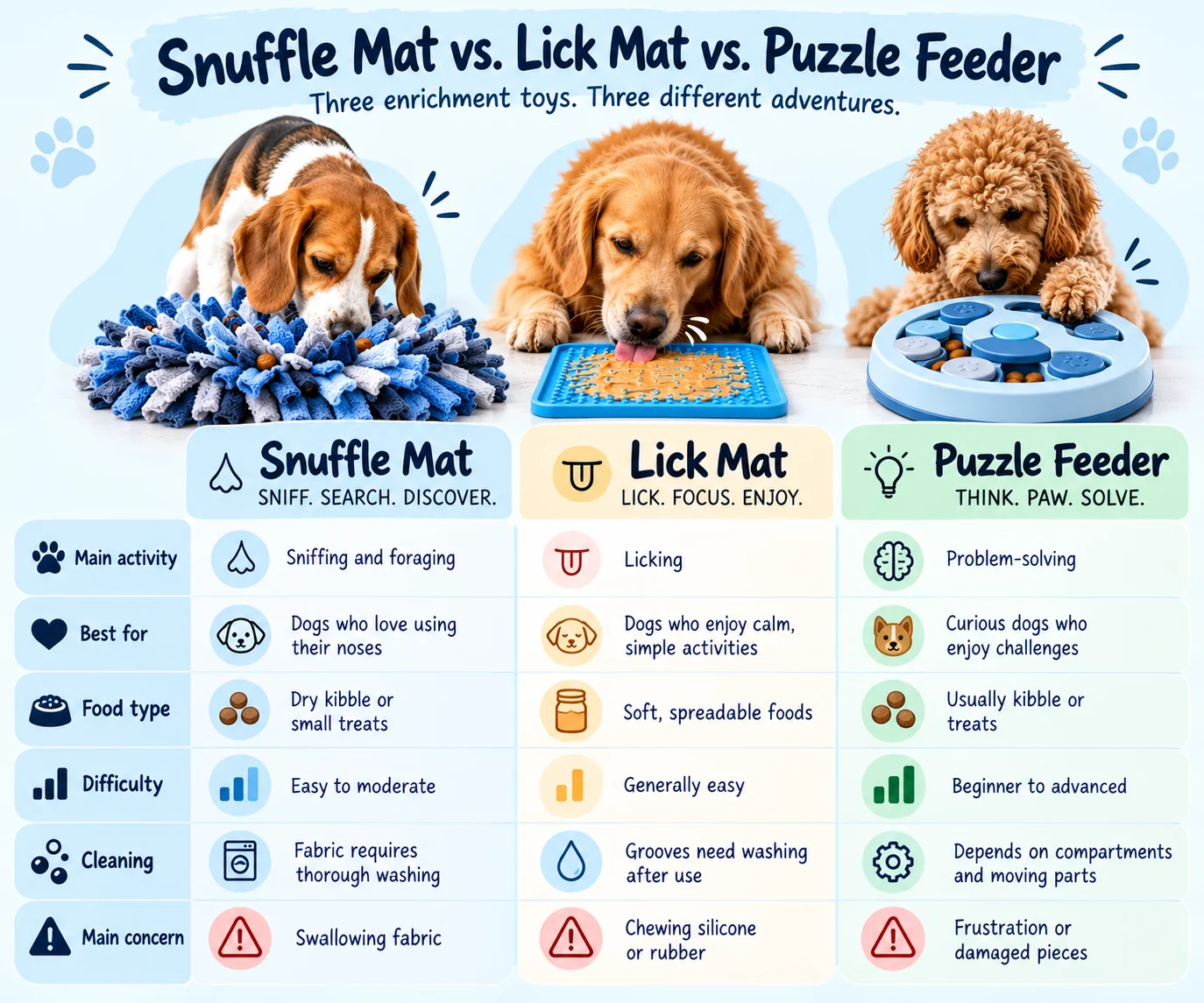
At a glance:
Snuffle mat: sniffing and foraging with dry kibble or small treats. Easy to moderate. Fabric needs thorough washing; the main concern is a dog swallowing fabric.
Lick mat: licking soft, spreadable food. Generally easy. Grooves need washing after every use; watch for chewing of the silicone or rubber.
Puzzle feeder: problem-solving with kibble or treats. Beginner to advanced. Cleaning depends on the compartments; watch for frustration or broken pieces.
The quick answer: Start with a snuffle mat for a dog who loves sniffing, a lick mat for an easy food activity, or a beginner puzzle feeder for a dog who enjoys figuring things out.
Of course, your dog may have other plans. Let’s look closer.
What Is a Snuffle Mat for Dogs?
Imagine a tiny indoor lawn made from fleece strips, except instead of grass, it grows breakfast.
That’s essentially a snuffle mat.
You scatter dry kibble or small treats into the fabric folds, and your dog uses their nose to find the food.
Instead of inhaling dinner from a bowl, they get to sniff, search, and investigate.
Why dogs enjoy snuffle mats
Dogs experience much of their world through smell. Sniffing and searching are natural behaviors, and a snuffle mat gives those instincts something productive to do. If your dog loves this kind of thing, our easy scent games for dogs are a fun next step.
The RSPCA identifies scent-based activities, including snuffle mats, as a form of enrichment that can support dogs’ engagement and well-being.
A snuffle mat can also make a portion of dry food take longer to eat because your dog has to locate the pieces individually.
That doesn’t mean it will solve every fast-eating problem, but it’s one option worth trying.
How to introduce a snuffle mat
Don’t start by burying every piece of kibble so deeply that your dog needs an excavation permit.
Make the first attempt easy.
Scatter a few pieces on top of the fabric where your dog can see them. Let them investigate and collect their reward.
Once they’ve figured out the game, tuck a few pieces deeper into the folds.
Keep sessions short at first. You’re introducing a fun activity, not assigning homework.
Which dogs are good candidates?
Snuffle mats may be especially appealing to dogs who:
Love sniffing during walks.
Enjoy searching for hidden treats.
Eat dry kibble quickly.
Prefer calmer, low-impact activities.
Are new to food-based enrichment.
One important warning: Dogs who shred blankets, pull stuffing from toys, or swallow fabric may not be good candidates. Loose fleece strips can become a choking or intestinal obstruction hazard.
Supervise every session and put the mat away when the food is gone.
What Is a Lick Mat for Dogs?
A lick mat looks like someone took a tiny rubber welcome mat and decided it needed more peanut butter.
It’s usually made from silicone or rubber with grooves, ridges, or raised patterns.
You spread a thin layer of soft, dog-safe food across the surface. Your dog then spends time licking the food out of those little spaces.
Simple? Absolutely.
Potentially entertaining? Ask a dog who’s just discovered pumpkin puree.
What are lick mats good for?
Lick mats are popular because they provide a relatively simple activity that doesn’t require much problem-solving.
They can be useful when you want to give your dog something to focus on while they’re settled nearby.
Some owners also use them during brushing, bathing, or other routine activities.
However, a lick mat isn’t a proven treatment for anxiety. If your dog is genuinely frightened or distressed, distracting them with food isn’t a substitute for addressing the underlying problem with appropriate professional guidance.
And if your dog is too stressed to eat, don’t force the activity.
What can you put on a lick mat?
You don’t need an elaborate recipe or a blender full of ingredients.
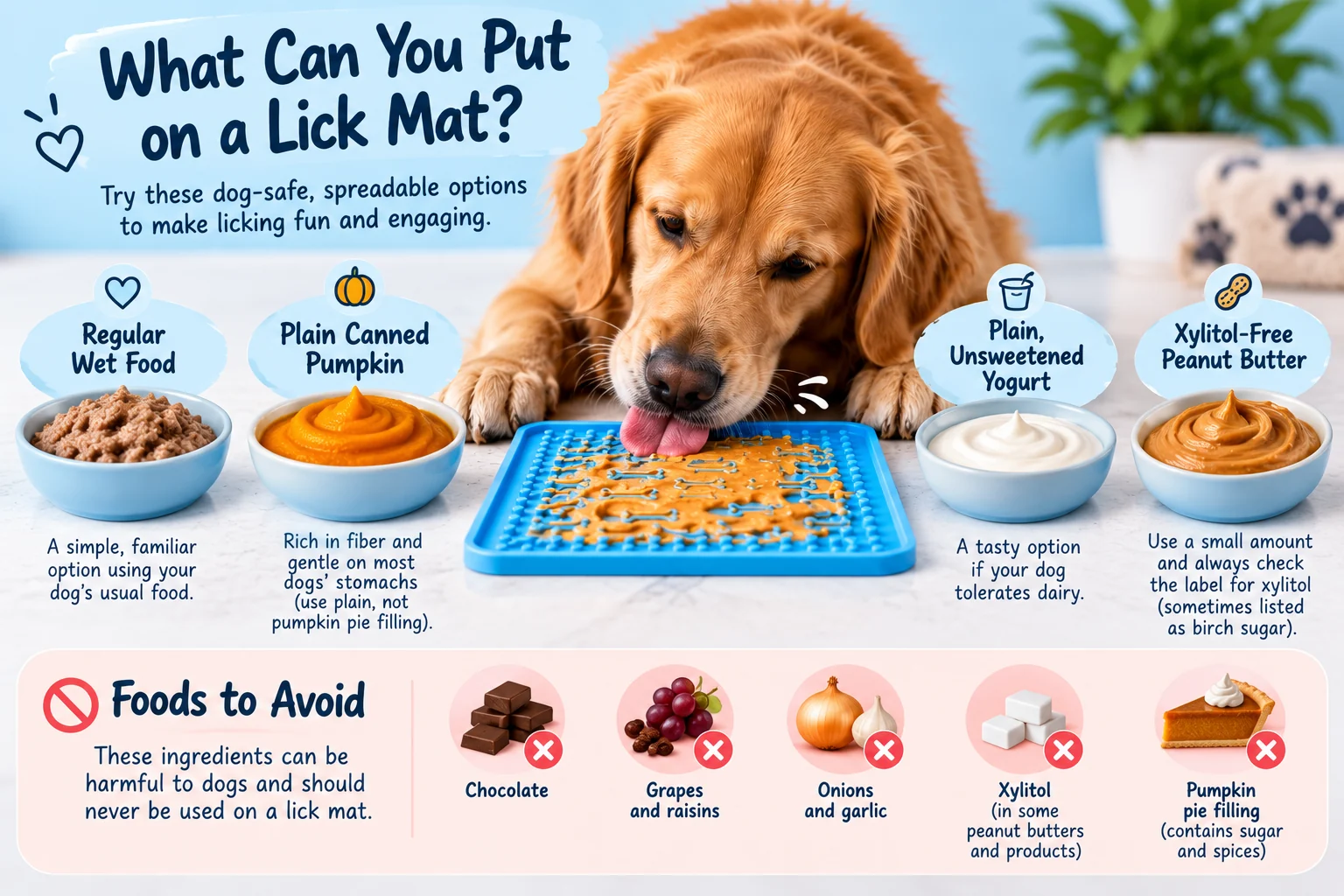
Try a thin layer of:
Your dog’s regular wet food.
Plain canned pumpkin, not pumpkin pie filling.
Plain, unsweetened yogurt, if your dog tolerates dairy.
A small amount of peanut butter that’s confirmed to be xylitol-free.
Regular dog food is often the easiest starting point because you’re not introducing a completely new treat.
Check every ingredient label. Xylitol, sometimes called birch sugar, is dangerous to dogs and can appear in certain nut butters and other human foods. The FDA specifically warns dog owners to check labels carefully.
Avoid chocolate, grapes, raisins, onions, garlic, and other ingredients known to be harmful to dogs.
And remember that the food on the mat counts toward your dog’s daily intake. A thin spread is plenty.
What about frozen lick mats?
Some dogs enjoy licking food that’s been chilled or frozen onto the mat.
You can try this if the mat’s manufacturer says freezing is appropriate and the food is suitable for your dog.
Start with an easy, unfrozen version first. You want your dog enjoying the activity, not trying to bite chunks of frozen food or chew the mat apart.
The biggest drawback
Some dogs eventually decide that licking is boring and chewing the entire mat sounds much more exciting.
If yours starts gnawing the edges, end the session.
Rubber and silicone pieces aren’t meant to be swallowed, no matter how confidently your dog disagrees.
What Is a Puzzle Feeder for Dogs?
A puzzle feeder is essentially a little problem-solving game with food as the prize.
Some have sliding panels. Others have rotating compartments, removable covers, or rolling mechanisms that release kibble.
The dog has to interact with the toy to get the food.
For certain dogs, this is the greatest invention since the unattended sandwich.
Why puzzle feeders can be useful
Puzzle feeders encourage dogs to experiment, investigate, and work through a challenge.
The RSPCA includes food-dispensing toys and puzzles among enrichment activities that can help keep dogs engaged.
The difficulty varies considerably between products, which makes choosing the right starting point important.
A dog who’s never used a puzzle feeder probably doesn’t need the canine equivalent of a graduate-level engineering exam.
Start with easy wins
Choose a beginner puzzle with simple movements.
If it has sliding compartments, leave them partly open at first. Let your dog see and smell the food.
Reward their curiosity by making the first few attempts easy.
Once they understand the game, gradually increase the challenge.
The goal is to build confidence, not test how long your dog can tolerate being annoyed.
How to tell if a puzzle is too difficult
Watch your dog’s behavior.
Possible signs of frustration include repeatedly barking at the toy, forcefully pawing or biting it, abandoning the activity, or becoming increasingly agitated.
If that happens, make the puzzle easier.
Help them succeed, then end the session on a positive note.
Some dogs love complicated challenges. Others would rather have their snacks delivered without a written examination.
Both are perfectly reasonable dogs.
Which Enrichment Toy Is Best for Your Dog?
Now for the question that actually matters.
If your dog eats meals in five seconds
Try: A snuffle mat or beginner puzzle feeder.
Both can spread dry kibble across an activity rather than presenting it in one convenient pile.
A purpose-made slow feeder bowl is another option worth considering.
If your dog frequently coughs, gags, regurgitates, or vomits around meals, speak with your veterinarian rather than assuming a slower feeder will fix the problem.
If your dog sniffs absolutely everything
Try: A snuffle mat.
You know the dog.
The one who needs to inspect every tree, mailbox, leaf, and mysterious patch of sidewalk before continuing a walk.
That dog may love searching through a snuffle mat.
You can also explore our 9 Easy Scent Games for Dogs article for more nose-powered entertainment.
If your dog is completely new to enrichment
Try: A lick mat or very easy snuffle mat.
Start with an activity that offers quick rewards.
You can introduce more complicated puzzles once you know what your dog enjoys.
If your dog loves solving problems
Try: A puzzle feeder.
Some dogs enjoy figuring out how things move, open, slide, and release food.
A puzzle feeder gives that curiosity an appropriate outlet.
Just remember that more difficult doesn’t automatically mean better.
If your dog gets frustrated easily
Try: A lick mat or beginner-level snuffle mat.
Keep things simple and rewarding.
An enrichment activity should be enjoyable, not a daily argument between your dog and a plastic contraption.
If your dog destroys every toy
Proceed carefully with all three.
Fabric mats can be shredded. Silicone mats can be chewed. Plastic puzzles can crack or lose parts.
Choose a design appropriate for your dog’s size and chewing habits, supervise closely, and remove damaged toys immediately.
Some dogs may be better suited to other supervised enrichment activities.
No product is indestructible or safe for every dog.
What to Look For When Shopping
You don’t need the most expensive enrichment toy on the shelf.
You need one that’s suitable for your dog, easy enough to use, and practical to maintain.
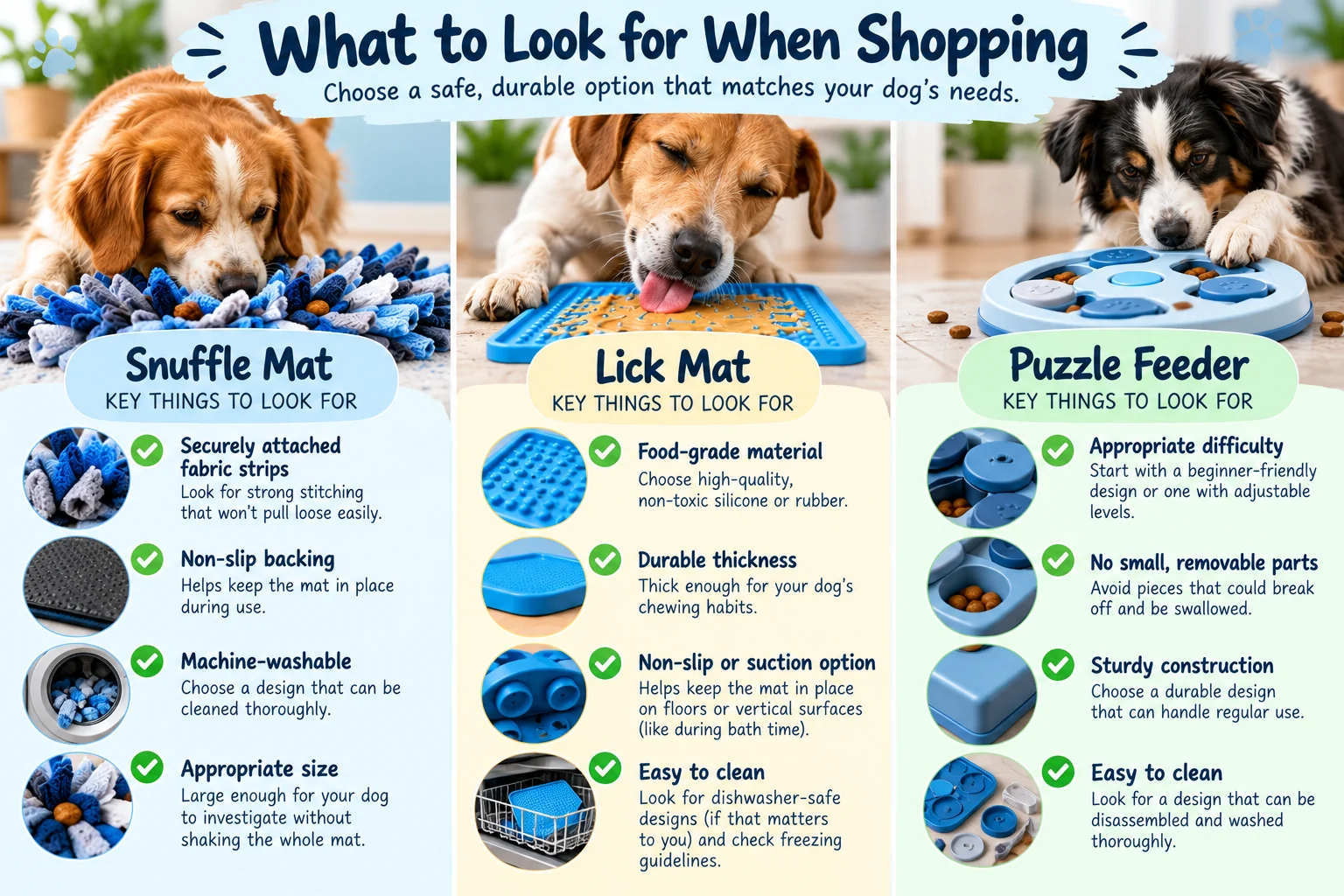
Here’s what matters.
Choosing a snuffle mat
Look for securely attached fabric strips that don’t pull loose easily.
A non-slip backing can help prevent the mat from sliding across the floor.
Check whether the entire mat can be washed thoroughly, especially if you plan to use it regularly.
And choose a size that gives your dog room to investigate without encouraging them to grab and shake the whole thing.
Our buying priority: Secure construction and easy cleaning over elaborate shapes or cute designs.
Choosing a lick mat
Look for food-safe materials, a texture that’s easy to clean, and a thickness appropriate for your dog’s habits.
Some mats include suction cups to help hold them in place. Those can be convenient, but suction isn’t a substitute for supervision.
Check the manufacturer’s instructions for dishwasher use, freezing, and cleaning.
Our buying priority: A simple, durable, easy-to-clean mat that’s appropriate for your dog.
Choosing a puzzle feeder
Start by checking the difficulty level.
Adjustable difficulty can be useful, but a beginner-friendly design matters more than a long list of complicated features.
Inspect moving parts and compartments for potential breakage or swallowing hazards.
Choose a size appropriate for your dog and a design you can clean without spending half your evening hunting for old kibble.
Our buying priority: Appropriate difficulty, sturdy construction, and safe, accessible compartments.
The Bark Clinic hasn’t independently hands-on tested specific products for this comparison. These recommendations focus on product features and general suitability rather than individual brand endorsements.
Can You Use All Three?
Absolutely.
In fact, rotating enrichment activities can be a nice way to add variety to your dog’s routine.
You might use a snuffle mat for breakfast, a lick mat during a quiet afternoon, and a beginner puzzle feeder on a rainy weekend.
You don’t have to use all three every day. Pay attention to which activities your dog genuinely enjoys.
And here’s a little secret: you don’t necessarily need to buy anything to get started.
Try scattering kibble in a safe, clean area for a simple search game. Or hide a few treats around a room and encourage your dog to find them.
You can also experiment with a loosely rolled towel containing a few pieces of kibble, provided your dog won’t chew or swallow the fabric.
For more budget-friendly ideas, check out 12 DIY Dog Enrichment Ideas Using Things You Already Have.
Your dog may end up preferring a homemade game to the fancy toy you spent twenty minutes researching.
That’s dogs for you.
Six Safety Rules for Dog Enrichment Toys
Enrichment should make your dog’s day better, not create an emergency vet visit.
Keep these six rules in mind.
1. Supervise your dog. Especially with a new toy, and particularly if your dog has a history of chewing or swallowing objects.
2. Inspect toys before every use. Loose fabric, cracks, torn silicone, and broken pieces are reasons to stop using a toy.
3. Count the calories. Use part of your dog’s regular meal when possible. Extra treats and spreads can add up quickly.
4. Choose safe ingredients. Read labels, avoid toxic foods, and introduce unfamiliar foods gradually.
5. Clean toys thoroughly. Wash lick mats after each use, follow manufacturer instructions for puzzles, and allow fabric mats to dry completely.
6. Give dogs their own space. In multi-dog households, separate food activities when necessary to reduce competition or guarding.
The RSPCA also cautions that poorly chosen enrichment activities can introduce risks, including swallowed toy pieces and excessive food intake.
If your dog swallows part of an enrichment toy, contact your veterinarian promptly. If you suspect a blockage or choking, seek urgent veterinary help.
Our article My Dog Ate Something They Shouldn’t: What to Do in the First 10 Minutes covers additional first steps.
Frequently Asked Questions
Are snuffle mats good for dogs?
They can be an enjoyable way to encourage sniffing and foraging, especially for dogs who enjoy scent-based activities. They’re best used under supervision and aren’t suitable for every dog, particularly those who chew or swallow fabric.
Are lick mats actually calming for dogs?
Some dogs appear to enjoy licking as a quiet, focused activity. However, lick mats shouldn’t be considered a proven treatment for anxiety or used to force a frightened dog through a stressful situation.
Can I leave my dog alone with a lick mat?
It’s safest to supervise. Some dogs chew the mat after finishing the food, creating a risk of swallowing rubber or silicone pieces.
Can I put peanut butter on a lick mat?
Yes, in a small amount, if it’s suitable for your dog and contains no xylitol. Check the complete ingredient list every time, and remember that peanut butter is calorie-dense.
How often should dogs use puzzle feeders?
There’s no universal schedule. Some dogs enjoy a simple puzzle during daily meals, while others prefer occasional sessions. Adjust the frequency and difficulty based on your dog’s interest, frustration level, and dietary needs.
Are puzzle feeders better than snuffle mats?
Not necessarily. Puzzle feeders emphasize manipulating objects to access food, while snuffle mats emphasize sniffing and foraging. The better choice depends on what your dog enjoys and can use safely.
What’s the best enrichment toy for a bored dog?
Start with your dog’s natural interests. A dog who loves sniffing may enjoy a snuffle mat, while a dog who enjoys manipulating toys may prefer a puzzle feeder. For a simple food activity, a lick mat could be a good starting point.
If you’re wondering whether your dog needs more stimulation, read Your Dog Is Bored, Not Bad: 7 Signs Your Dog Needs More Enrichment.
Final Verdict: Let Your Dog Pick the Winner
Still can’t decide?
Start with your dog’s favorite activity.
If they spend every walk investigating every blade of grass, try a snuffle mat.
If they enjoy slowly working food out of a textured surface, a lick mat might be their new favorite thing.
And if they’re constantly figuring out how to open doors, investigate cupboards, or manipulate toys, a beginner puzzle feeder could be right up their alley.
You can always try more than one. The goal isn’t to collect every dog enrichment toy on the market. It’s to find a few safe, enjoyable activities that make everyday life a little more interesting.
And if your dog ignores the expensive puzzle feeder and spends twenty minutes investigating the cardboard box it arrived in?
Congratulations.
Your dog has opinions.
Helpful Sources
This article provides general dog-care education and isn’t a substitute for individualized veterinary advice.
This article is educational and is not a substitute for veterinary care. If your dog is unwell, contact your veterinarian.
Keep reading
15 Christmas Gifts for Dogs Who Already Have Everything (Except Self-Control)
Your dog already owns 47 toys, three beds, and approximately 80% of your couch. Here’s how to find a Christmas present they’ll actually enjoy.
Read article
Christmas Gifts for Dogs Who Destroy Every Toy: 11 Smarter Ideas
Your dog turned last year’s Christmas present into confetti before breakfast. These gift ideas focus on safer chewing, enrichment, and lasting entertainment.
Read article
7 Strange Things Dogs Do When They Really Trust You
Your dog follows you into the bathroom, steals your spot on the couch, and sleeps like a furry pretzel. Could these strange habits actually be signs of trust? Let's decode the adorable weirdness.
Read article