Your dog does not know the difference between a $38 enrichment toy and the cardboard box it arrived in.
Honestly, sometimes they prefer the box.
That's one of the best things about dog enrichment. You don't necessarily need another Amazon order or an entire cabinet dedicated to puzzle toys.
Sometimes you need a towel.
Or a muffin tin.
Or one of the 47 cardboard boxes you haven't gotten around to recycling yet.
DIY dog enrichment can be cheap, easy to change and surprisingly effective because you're giving your dog something new to investigate, sniff and figure out.
But before we raid the recycling bin, there's one rule:
DIY does not mean unsupervised.
Cardboard is great for a dog who likes nosing through boxes. It's considerably less great for a dog who believes cardboard is an underappreciated food group.
The same goes for towels, plastic containers and anything else we're about to use.
Know your dog. Supervise the activity. And if your dog is more interested in eating the puzzle than solving it, use a purpose-built alternative.
Okay.
Now we can raid the house.
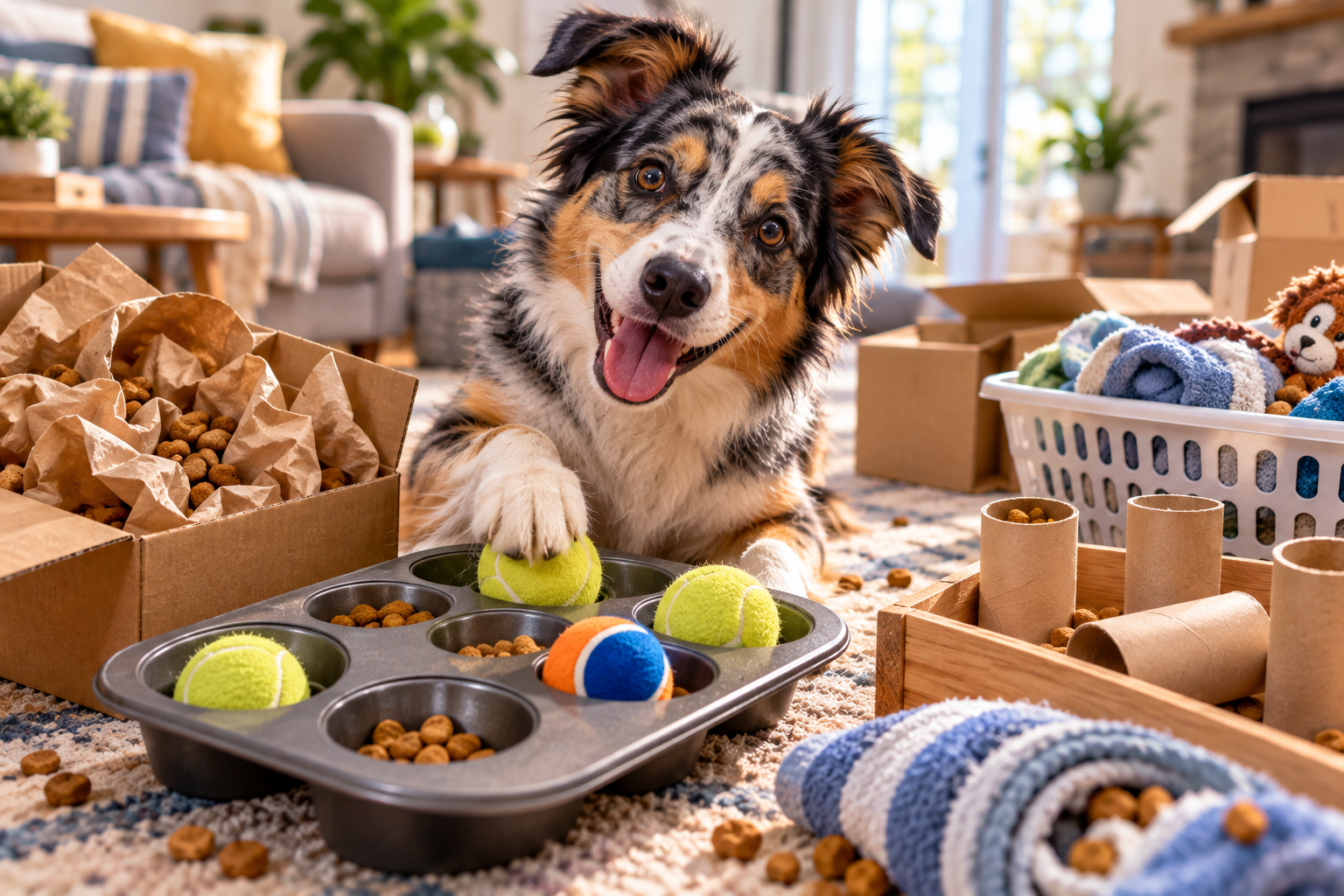
Start with the muffin tin in your kitchen
This is one of those games that almost feels too simple to count.
Grab a muffin tin and put a few pieces of kibble into several of the cups.
Then cover some of them with appropriately sized balls or dog toys.
That's it.
Your dog now has to figure out how to move the objects to get the food underneath.
The nice thing about this game is how easily you can change it.
For your dog's first attempt, leave several treats completely uncovered so the objective is obvious.
Once they understand what's happening, cover all of the cups containing food.
Later, only put food underneath some of them.
Now your dog isn't simply knocking things around.
They're starting to investigate which compartments are actually worth opening.
Congratulations.
Your muffin tin has a second job.
An old towel can become a puzzle in about 30 seconds
Lay a towel flat on the floor.
Scatter some of your dog's kibble across it.
Then loosely roll the towel.
Give it to your dog and let them figure out the rest.
Some dogs immediately start pushing it around with their noses. Others paw at it. Some stare at you as if you've clearly made a mistake while serving dinner.
Give them a minute.
Once your dog understands that unrolling the towel reveals food, you can make the next round slightly harder by adding a few gentle folds.
Just don't turn it into Fort Knox.
The point is to make breakfast interesting, not to administer the canine SAT.
And if your dog eats fabric?
Skip this one completely.
Put those delivery boxes to work
If your house is anything like ours, finding a cardboard box shouldn't be difficult.
Grab several different sizes.
Put a treat inside the smallest open box, then place that box inside a larger open one.
Leave everything wide open the first time.
Your dog should be able to sniff around, stick their head inside and discover the reward without much trouble.
Once they've figured out the idea, rearrange the boxes or change their positions.
What you don't need is tape, staples or some elaborate cardboard engineering project.
Your dog is supposed to solve a puzzle.
They're not supposed to dismantle office supplies with their mouth.
Packing paper makes the box even better
You know all that brown packing paper companies stuff into boxes?
Don't throw it away just yet.
Loosely crumple some plain packing paper into an open box and sprinkle kibble among it.
Then let your dog investigate.
This is where personalities really come out.
One dog will carefully sniff between every piece of paper like an archaeologist examining an ancient site.
Another will shove their entire head into the box and begin what appears to be a home-demolition show.
Both approaches are acceptable.
The important distinction is whether your dog is moving and shredding the paper or actually swallowing it.
Shredding can be part of the fun for some dogs.
Eating the equipment means the game is over.
Don't throw away those cardboard tubes either
Empty paper tubes can become another ridiculously cheap game.
Instead of stuffing food inside and sealing the ends—which can encourage some dogs to chew through and swallow the cardboard—stand several tubes upright inside an open box.
Drop kibble into a few of them.
Then let your dog knock them over and search.
You can even scatter a couple of pieces around the bottom of the larger box to make the first attempt easier.
Again, cardboard games aren't appropriate for every dog.
If yours takes one look at the setup and thinks, Excellent, appetizers, move on.
Turn a few cups into a guessing game
Grab several sturdy cups and place them upside down on the floor.
Hide a piece of kibble underneath one.
Let your dog investigate.
When they find the correct cup, lift it and let them have the reward.
Once your dog understands what's happening, change the positions or hide food underneath two cups.
It's basically the world's cheapest game show.
And unlike us, your dog isn't watching the cups.
They're using their nose.
Your blanket pile can become a giant snuffle mat
You don't necessarily need a dedicated snuffle mat to create a sniffing game.
Loosely bunch together a couple of safe blankets or towels and sprinkle kibble among the folds.
Don't bury everything six layers deep on the first attempt.
Leave some pieces visible.
Once your dog understands that food is hiding inside the folds, tuck pieces a little farther in.
Now breakfast takes some investigation.
This is another game where knowing your dog matters.
If towels are for sniffing and nosing, fantastic.
If towels are apparently delicious, we're done here.
Leave a trail through the house
Take individual pieces of kibble and create a little trail across the room.
For the first attempt, keep the pieces relatively close together.
At the end, leave something worthwhile—a favorite toy, part of their meal or a slightly bigger food reward.
Once your dog figures out the concept, start spacing the pieces farther apart.
Add a turn.
Go around a piece of furniture.
Eventually your dog has to stop relying on seeing the next piece and start using their nose to figure out where the trail continues.
This is one of our favorites because you can make it slightly different every time without buying anything.
Even the laundry basket can get involved
Take a sturdy laundry basket and put several of your dog's toys inside.
Scatter some kibble among them.
Now your dog has to nose through the collection to find the food.
Simple.
But check the basket first.
Avoid anything with cracked plastic, sharp edges or openings where your dog's collar, tags, paw or jaw could become caught.
And make sure your dog can't get their head stuck.
If you're looking at your laundry basket thinking, Yeah, I'm not sure about this, trust that instinct.
Use an open cardboard box instead.
We don't need to get creative enough to require an explanation at the emergency vet.
You can make a frozen meal last much longer
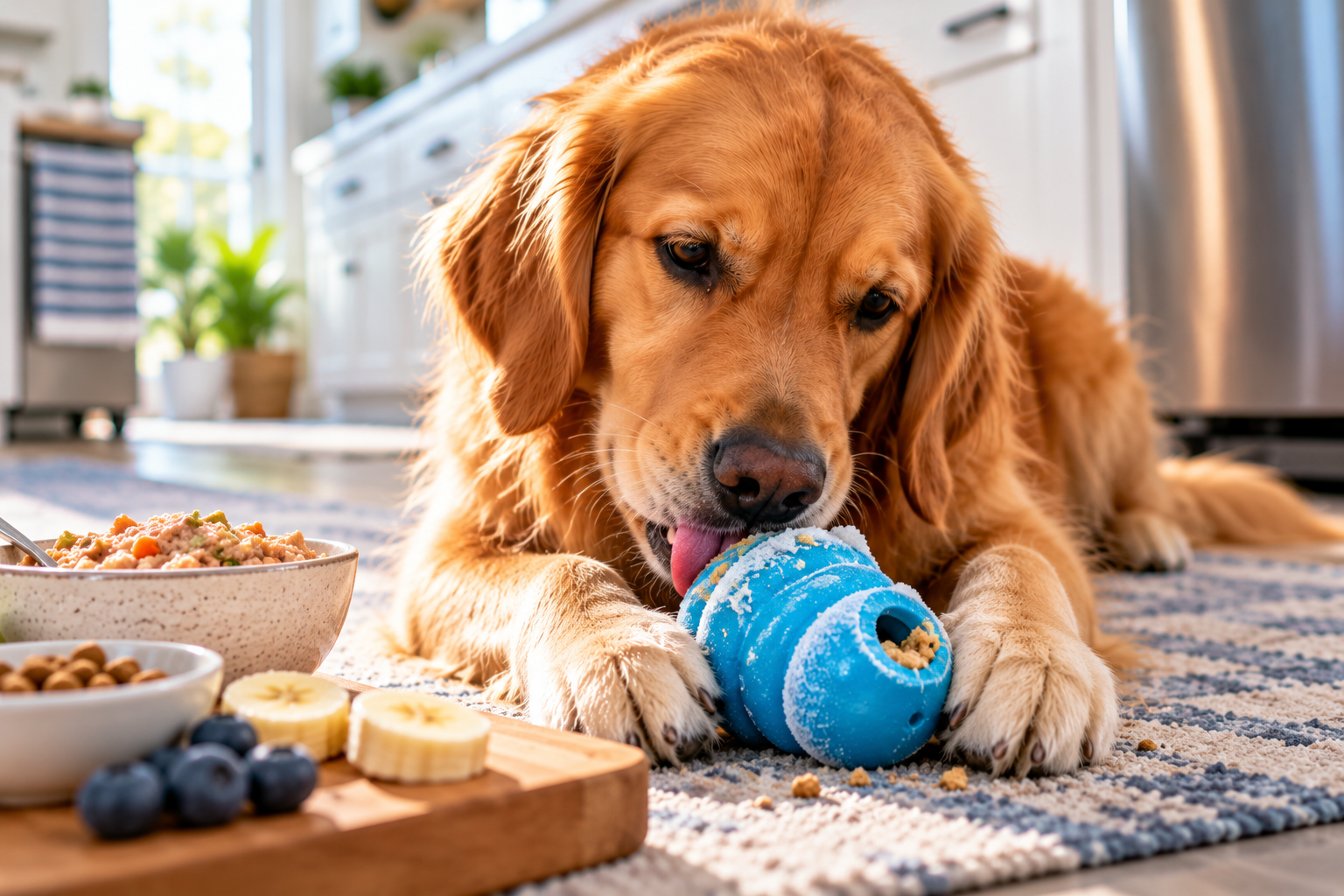
Okay, we're cheating slightly on this one because you'll need a purpose-built food toy.
But you don't need some elaborate recipe to fill it.
Use part of your dog's normal wet food or appropriately moistened kibble.
Fill the toy.
Freeze it.
Now a meal that might normally disappear in 30 seconds becomes something your dog has to work through.
The important part is that we're using food they were already going to eat.
Enrichment doesn't have to mean piling an extra mountain of treats on top of your dog's regular calories.
Just choose a food toy that's appropriately sized and durable for your dog, and supervise its use.
Three cardboard boxes can become a memory game
Put three open boxes several feet apart.
While your dog watches, drop some kibble into one.
Release them and let them choose.
Easy.
Reset everything and do it again.
Once your dog understands what's happening, briefly block their view while you hide the food.
Now things get more interesting.
Your dog has to investigate rather than simply walking toward the box they watched you bait.
Move the boxes around between rounds and you've created a game involving scent, memory and problem-solving with three objects that were headed for the recycling bin.
Not bad.
Build the world's least impressive obstacle course
You do not need agility equipment.
You need a little floor space and whatever safe objects happen to be nearby.
Put down a cardboard box.
Add a mat.
Place two chairs several feet apart.
Maybe put a rolled towel with kibble at the end.
Now walk your dog through it.
Go around the box.
Step onto the mat.
Walk between the chairs.
Find the kibble.
Touch your hand.
Circle back around the box.
Is anyone from ESPN going to televise this event?
Probably not.
Does your dog care?
Absolutely not.
You're asking them to move, think, interact with you and experience familiar objects in a different way.
That's the whole point.
Here's how to keep these games interesting
This is where a lot of DIY enrichment advice stops too early.
You don't need to keep finding completely new activities.
You can progress the ones your dog already understands.
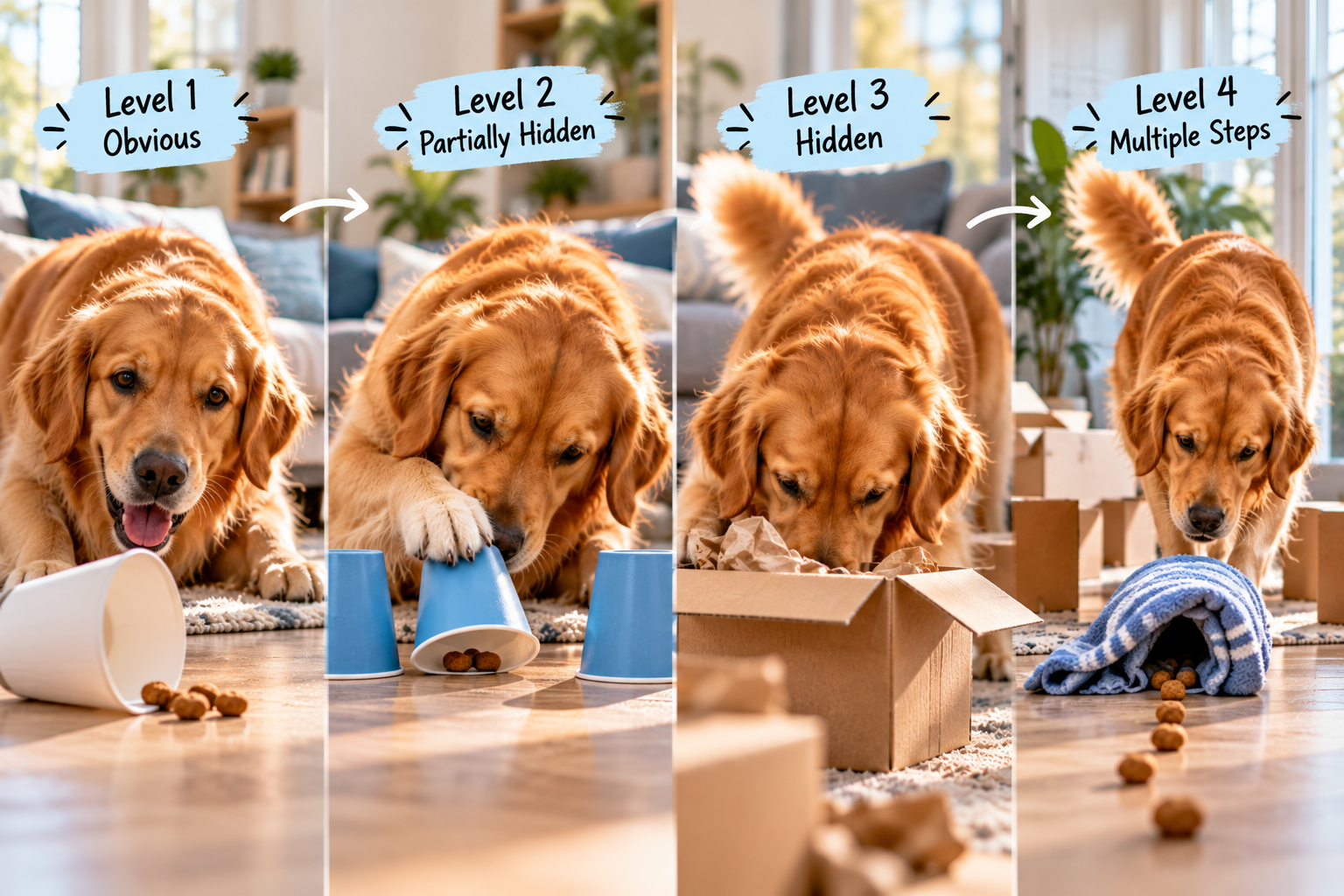
Think of it as a difficulty slider.
At first, make the food obvious.
Your dog learns, Hey, interacting with this weird thing pays.
Next time, partially hide it.
Then make your dog move something to reach it.
Eventually, hide the food completely so scent becomes more important.
Later, combine two simple actions.
Move something. Search. Find the reward.
And once your dog knows the game really well, try the same activity somewhere different.
A familiar puzzle in a new room can suddenly feel new again.
The trick is to change one major thing at a time.
If you make the puzzle harder, move it into a strange room and switch to a reward your dog doesn't care about—all at once—don't be surprised when your dog resigns from the position.
Sometimes DIY isn't the right choice
Some dogs simply aren't good candidates for homemade puzzles.
If your dog routinely eats cardboard, swallows fabric, destroys plastic or gulps small objects, purpose-built enrichment toys are probably the better option.
The same applies if an activity causes your dog to become increasingly frustrated instead of curious.
And pay particular attention to food guarding.
If your dog freezes, stiffens, growls or becomes protective when you approach an enrichment item, don't grab it and turn the situation into a confrontation.
Give your dog space.
Food and toy guarding can be a serious behavior issue, and getting qualified professional guidance is a much better plan than trying to win a tug-of-war over a cardboard box.
Is your dog actually enjoying this?
This is worth asking because enrichment isn't automatically good just because we call it enrichment.
Watch your dog.
Are they sniffing?
Investigating?
Trying different approaches?
Going back to the activity voluntarily?
Do they seem satisfied or relaxed afterward?
Those are encouraging signs.
Now compare that with a dog who's repeatedly barking at the puzzle, frantically biting it, immediately giving up or trying desperately to swallow the materials.
That's telling you something too.
The goal isn't to prove your dog is capable of solving the hardest puzzle you can invent.
You're trying to give them an enjoyable problem to solve.
There's a difference.
The Bark Clinic Bottom Line
The best DIY enrichment toy in your house might currently be sitting in the recycling bin.
But remember:
The object isn't what makes enrichment good. The experience does.
Start ridiculously easy.
Supervise.
Use part of your dog's normal meals when you can.
Pay attention to how your dog interacts with different materials.
And make the game harder only after your dog understands it.
Most importantly, don't judge an activity by how long it took you to make it.
If you spend 20 minutes constructing a magnificent cardboard puzzle and your dog solves the entire thing in 11 seconds, the activity didn't fail.
You've apparently raised an engineer.
Time to build version two.
This article is educational and is not a substitute for veterinary care. If your dog is unwell, contact your veterinarian.