You hear chewing from the other room.
Your dog is standing beside an overturned bottle, shredded package or suspiciously empty food wrapper.
And suddenly you’re trying to answer one very important question:
What did my dog just eat — and what do I do now?
If your dog ate something they shouldn’t have, don’t wait for symptoms before figuring out your next move. Some foods, medications, household products and foreign objects can cause serious problems before a dog looks sick.
The good news is that you don’t need to diagnose the problem yourself.
You need to identify what your dog ate, estimate how much they ate, prevent them from getting any more of it and contact the appropriate veterinary professional quickly.
The Bark Clinic Quick Answer: If your dog may have swallowed something toxic or dangerous, remove access to it, save the packaging, estimate when and how much was eaten, and call your veterinarian, an emergency veterinary hospital or an animal poison-control service. Do not make your dog vomit or give them a home remedy unless a veterinary professional specifically tells you to.
My Dog Ate Something They Shouldn’t. What Should I Do First?
The first few minutes can feel chaotic, so forget about trying to remember everything you’ve ever read about dog poisoning.
Start here.
1. Get your dog away from whatever they ate
Remove the food, medication, chemical, plant or object so your dog can’t swallow any more.
If other pets are nearby, keep them away too.
Don’t spend the next five minutes cleaning the kitchen. Your priority is figuring out what happened.
2. Check your dog
Is your dog:
Conscious and responsive?
Breathing normally?
Able to stand and walk normally?
Vomiting repeatedly?
Trembling or having a seizure?
Collapsing?
Having difficulty breathing?
A dog experiencing severe symptoms needs immediate veterinary attention.
But there’s another important point:
A dog acting completely normal does not necessarily mean they’re safe.
Some toxic exposures don’t cause obvious symptoms immediately.
3. Figure out exactly what your dog ate
Grab the package, bottle, label or remaining material.
Look for the exact product name and ingredient list.
For example, “my dog ate gum” isn’t nearly as useful as:
“My 45-pound dog may have eaten six pieces of sugar-free gum containing xylitol about 15 minutes ago.”
Those details can completely change the response.
4. Estimate how much is missing
You don’t have to know the exact amount.
Make your best estimate.
Was it:
One pill or several?
One piece of gum or the entire pack?
A bite of chocolate or half the bag?
One grape or a handful?
A small piece of a toy or a large chunk?
If you’re unsure, say so.
Don’t underestimate the amount just because you’re hoping your dog didn’t eat much.
5. Write down when it happened
Even an approximate time helps.
Treatment options can depend partly on how recently your dog swallowed something, so “about 10 minutes ago” is valuable information.
6. Call for professional guidance
Depending on the situation, contact:
Your regular veterinarian
The nearest emergency veterinary hospital
ASPCA Animal Poison Control Center
Pet Poison Helpline
Have your dog’s approximate weight, age, medical conditions and medications available if possible.
Also have the product or packaging beside you while you call.
The 60-Second Dog Ingestion Checklist
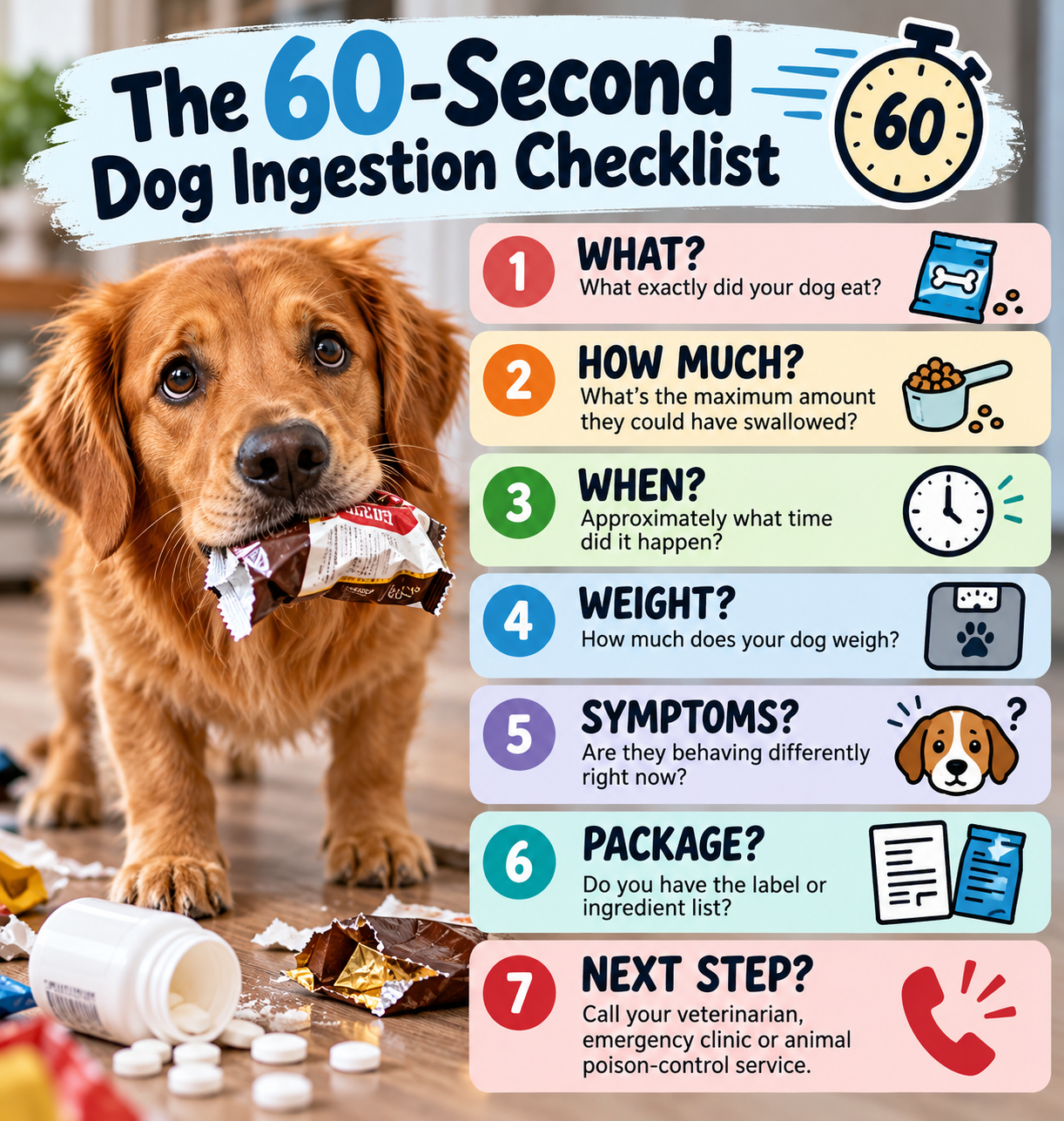
If you’re panicking, screenshot this section.
WHAT: What exactly did your dog eat?
HOW MUCH: What’s the maximum amount they could have swallowed?
WHEN: Approximately what time did it happen?
WEIGHT: How much does your dog weigh?
SYMPTOMS: Are they behaving differently right now?
PACKAGE: Do you have the label or ingredient list?
NEXT STEP: Call your veterinarian, emergency clinic or animal poison-control service.
Those seven pieces of information can turn “My dog ate something!” into information a professional can actually use.
Don’t Automatically Make Your Dog Throw Up
This is one of the most important things to know about what to do when a dog eats something dangerous.
Do not automatically induce vomiting.
It sounds logical: If something dangerous went down, get it back up.
Unfortunately, it isn’t always safe.
Some substances can cause additional damage when they travel back through the esophagus. Vomiting can also be dangerous when a dog has swallowed certain sharp objects or is experiencing neurological symptoms.
Veterinary toxicology guidance also warns against attempting to induce vomiting when there’s a significant risk of aspiration.
That means the correct question isn’t:
“How do I make my dog throw up?”
It’s:
“Should my dog be made to vomit in this specific situation?”
Let your veterinarian or poison-control professional answer that.
Don’t Try Internet Home Remedies
A poisoning emergency is not the time to experiment with something you found in a comment section.
Don’t give your dog salt, cooking oil, milk, mustard, activated charcoal or another supposed “antidote” unless a veterinary professional specifically instructs you to use it.
Even treatments that veterinarians sometimes use aren’t appropriate for every toxin or every dog.
The substance, dose, timing, dog’s size and dog’s condition all matter.
Common Things Dogs Eat That Can Be Dangerous
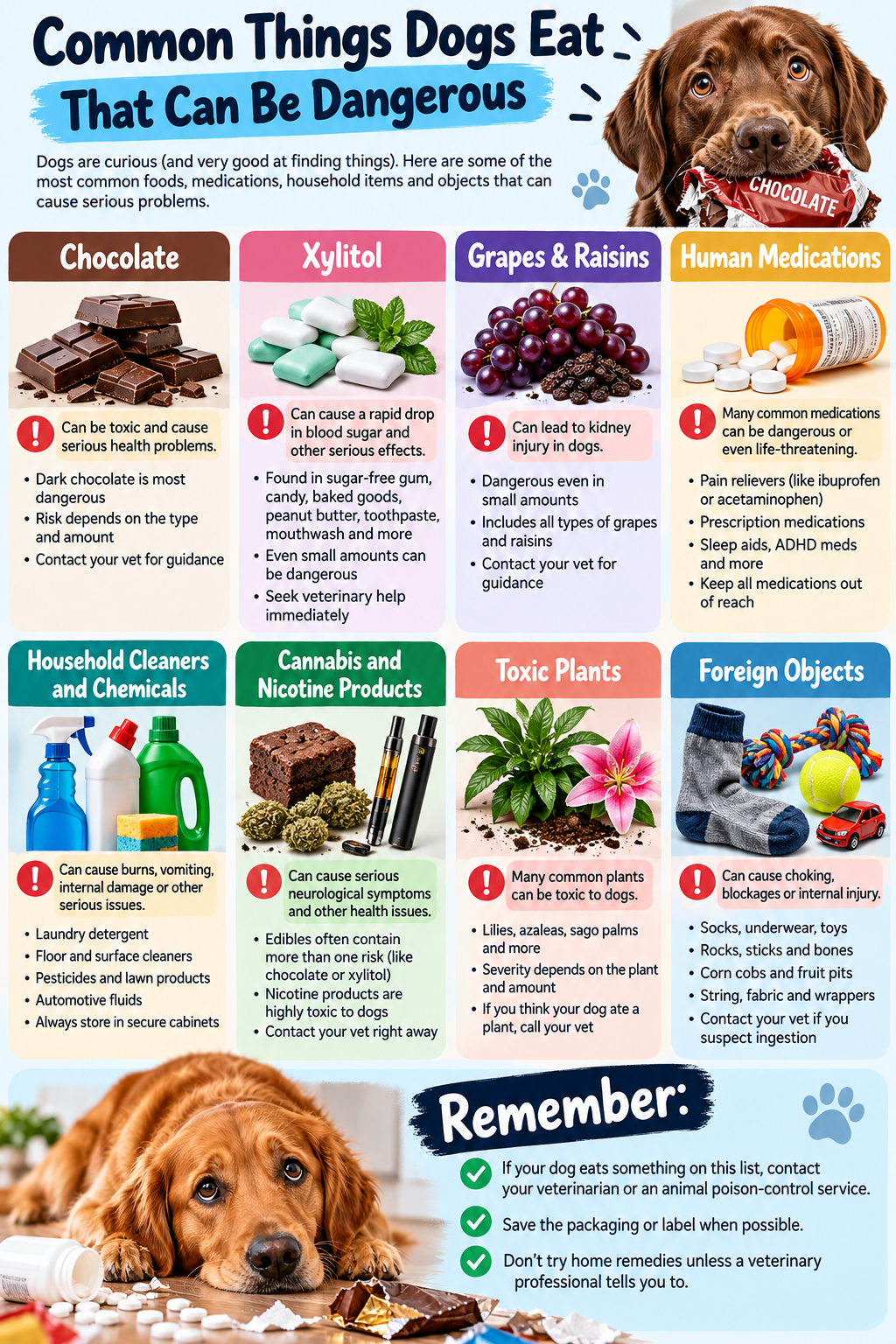
Dogs have an impressive ability to discover things nobody imagined they’d want to eat.
Some potentially dangerous exposures are obvious.
Others aren’t.
Chocolate
Chocolate toxicity depends on several factors, including the type of chocolate, amount eaten and size of the dog.
A tiny lick and an entire bag of baking chocolate are very different situations.
If your dog ate chocolate, save the wrapper and determine:
Type of chocolate
Approximate amount
Cocoa percentage if listed
Your dog’s weight
Approximate time it was eaten
Don’t wait for symptoms to decide whether the amount is dangerous.
Xylitol
Treat suspected xylitol ingestion seriously.
Xylitol is a sweetener that may appear in sugar-free gum, candies, baked goods, some nut butters, toothpaste, mouthwash, cough syrups, medications and supplements.
It may also appear on labels under names such as birch sugar or wood sugar.
Xylitol can cause a dangerous drop in a dog’s blood sugar, and serious effects can develop rapidly.
If your dog ate a product containing xylitol, contact a veterinarian or animal poison-control service immediately.
Grapes and Raisins
Grapes and raisins can be dangerous to dogs and have been associated with kidney injury.
This isn’t something we’d recommend trying to calculate yourself based on something you read online.
If your dog ate grapes or raisins, contact your veterinarian or animal poison control for guidance.
Human Medications
One dropped pill can become a dog treat remarkably quickly.
Common household medications — including pain relievers, prescription medications, sleep aids and other drugs — can be dangerous to dogs.
If your dog ate human medication, find the bottle.
You’ll want:
Exact medication name
Strength, such as milligrams per tablet
Maximum number of missing pills
Whether the medication is extended-release
Your dog’s weight
Approximate time of ingestion
Don’t give another medication to “counteract” it unless directed by a veterinarian.
Household Cleaners and Chemicals
Laundry products, cleaners, automotive fluids, pesticides and other household chemicals can create very different types of emergencies.
If possible, photograph or bring the original label with you.
Don’t intentionally make your dog vomit after swallowing a chemical unless a veterinary professional tells you to.
Cannabis and Nicotine Products
Edibles create an additional problem because they may contain more than one potentially harmful ingredient.
For example, a cannabis edible could also contain chocolate or xylitol.
Nicotine products — including cigarettes, vaping liquids and nicotine-containing products — can also be dangerous.
Tell the veterinarian exactly what your dog may have eaten.
This isn’t the time to be embarrassed about what’s in the house.
Accurate information helps your dog.
What If My Dog Swallowed an Object Instead of Something Toxic?
Not every dangerous thing a dog eats is poisonous.
Sometimes the problem is that the object simply isn’t supposed to travel through a dog.
Common examples include:
Socks
Underwear
Corn cobs
Bones
Rocks
Children’s toys
Pieces of dog toys
String
Fabric
Food wrappers
Fruit pits
Foreign objects can become lodged in the esophagus or create a gastrointestinal obstruction.
Sharp objects can also damage tissue.
Don’t assume “they’ll poop it out”
Sometimes dogs pass swallowed objects without a problem.
Sometimes they don’t.
The size and shape of the object, the dog’s size, where the object is located and how long ago it was swallowed can all influence what happens next.
Call your veterinarian for guidance rather than waiting several days to see what appears in the backyard.
And don’t pull string or similar material that’s protruding from your dog’s mouth or rectum without veterinary guidance.
Signs Your Dog Needs Emergency Veterinary Care
Seek immediate veterinary attention if your dog develops symptoms such as:
Difficulty breathing
Collapse
Seizures
Severe weakness
Loss of consciousness
Significant tremors
Repeated vomiting
Severe disorientation
Inability to stand normally
Significant abdominal pain or swelling
Choking or obvious airway obstruction
But remember:
You do not need to wait for these symptoms before calling.
If you know your dog swallowed something potentially toxic, getting professional guidance before symptoms appear can be extremely important.
What Should I Bring to the Emergency Vet?
If you’re told to bring your dog in, grab whatever will help identify the exposure without delaying your departure.
Bring the original:
Food package
Medication bottle
Chemical container
Product label
Ingredient list
If carrying the product isn’t practical or safe, take clear photos of the front label, ingredients and relevant concentration information.
Tell the veterinary team approximately when the exposure occurred and the maximum amount your dog might have consumed.
What If I Don’t Know What My Dog Ate?
This is the nightmare version of the situation:
There’s shredded packaging everywhere, something is obviously missing, and you have no idea what your dog actually swallowed.
Don’t waste valuable time trying to solve the mystery perfectly.
Look around the area.
Check for:
Torn wrappers
Open medication bottles
Missing pills
Chewed household products
Damaged plants
Pieces of toys
Food remnants
Chemical residue
Missing personal items
Take pictures of the scene before cleaning it up.
Then contact your veterinarian.
Even incomplete information can be useful.
Should I Wait and See If My Dog Gets Sick?
If your dog may have eaten something potentially toxic, “wait and see” shouldn’t be your default strategy.
Some exposures are easier to manage when they’re addressed early.
The same applies to swallowed objects. Waiting until a gastrointestinal obstruction produces obvious symptoms may turn a manageable situation into a much more serious one.
Making a phone call doesn’t automatically mean your dog needs emergency treatment.
Sometimes the professional on the other end may determine that the exposure isn’t expected to cause a problem.
That’s a much better conclusion to reach with professional guidance than by guessing.
Before an Emergency Happens: Do This Tonight
Nobody expects their dog to eat something dangerous at 11:47 p.m.
That’s usually when dogs schedule these things.
Spend five minutes preparing now.
Save the phone numbers for:
Your regular veterinarian
Your nearest 24-hour emergency veterinarian
ASPCA Animal Poison Control Center: 888-426-4435
Pet Poison Helpline: 855-764-7661
Poison-control services may charge a consultation fee, but having the numbers saved means you’re not frantically searching for them while your dog is sitting beside an empty package of sugar-free gum.
You should also know your dog’s approximate current weight.
That number can be extremely important when evaluating an exposure.
How to Prevent Your Dog From Eating Something Dangerous Again
After the crisis passes, figure out how your dog got access to the item.
And don’t beat yourself up.
Dogs are opportunists.
A bottle pushed slightly too close to the counter’s edge, an unzipped backpack or a guest leaving gum on a nightstand can be all it takes.
Instead, fix the weak point.
Store medications in closed cabinets. Keep bags and purses off the floor. Check ingredient labels on sugar-free products. Use a trash can your dog can’t open. Keep dangerous foods away from counter surfers.
And if your dog is particularly talented at eating things that aren’t food, management matters even more.
The goal isn’t to create a house where nothing ever goes wrong.
It’s to make the dangerous stuff harder to reach.
Frequently Asked Questions
What should I do immediately if my dog ate something toxic?
Remove your dog from the substance so they can’t eat more. Identify the product, estimate how much was consumed and when it happened, and contact your veterinarian, an emergency veterinary hospital or an animal poison-control service. Don’t induce vomiting or give a home remedy unless you’re specifically instructed to do so.
Should I make my dog throw up after eating something bad?
Not without professional guidance. Vomiting may be appropriate for some ingestions but dangerous for others. Certain chemicals, sharp objects and medical conditions can make inducing vomiting unsafe.
My dog ate something bad but seems fine. Should I still call the vet?
Yes, if the substance or object could be dangerous. Some toxic exposures don’t produce immediate symptoms, so a normal-looking dog isn’t proof that the ingestion was harmless.
How quickly do poisoning symptoms appear in dogs?
It depends on the substance. Some toxins can produce effects quickly, while others may take hours or longer. Xylitol is one example where signs can develop rapidly. Don’t use the absence of immediate symptoms as your only reason to wait.
What information will the veterinarian need?
Be ready with your dog’s weight, age, symptoms, what they ate, approximately how much they ate, when it happened and the product’s ingredient list or medication strength when available.
What if my dog ate a sock, toy or other object?
Contact your veterinarian. Foreign objects can sometimes pass naturally, but others can cause choking, gastrointestinal obstruction or internal injury. What happens next depends on the object, its size and shape, your dog’s size and how recently it was swallowed.
The Bark Clinic Bottom Line
Dogs don’t understand that a dropped pill isn’t a treat or that the sugar-free gum sitting inside your backpack could hurt them.
They just know they found something interesting.
If your dog eats something they shouldn’t, your job isn’t to become a veterinary toxicologist in ten minutes.
Your job is much simpler:
Stop further exposure.
Figure out what they ate.
Estimate how much and when.
Save the packaging.
Call someone qualified to tell you what happens next.
And whatever you do, don’t let an internet home remedy turn one problem into two.
When you’re unsure, making the call is the safer move.
This article is educational and is not a substitute for veterinary care. If your dog is unwell, contact your veterinarian.
Keep reading
The 10-Minute Fall Backyard Dog Safety Check
Closing up the backyard for fall? Take 10 minutes to walk through it from your dog’s point of view and catch the things hiding under furniture, behind planters and around the yard before your dog does
Read article
Dog First Aid Kit: What You Actually Need (and What You Don’t)
What actually belongs in a dog first aid kit? Here’s our practical checklist of useful supplies, what to skip, and how to prepare before your dog has an emergency.
Read article
Does My Dog Need Stitches? What to Do When Your Dog Gets Cut
Your dog got cut, there’s blood, and now you’re wondering whether this is a clean-it-at-home situation or a trip to the vet. Here’s how to make that decision without panicking.
Read article