
You walk into the living room and find the couch cushion torn open. There’s stuffing everywhere. One of your socks has somehow made it into the hallway, the matching sock is nowhere to be found, and your dog is sitting in the middle of the crime scene looking completely innocent.
It’s easy to think: Why is my dog being so bad?
But there may be another explanation.
Your dog might simply be bored.
Dogs need more than food, water, a comfortable place to sleep and a couple of trips outside each day. They also need opportunities to sniff, explore, play, solve problems and interact with the people around them.
When they don’t get enough of that stimulation, dogs are pretty good at inventing their own entertainment.
Unfortunately, their idea of entertainment may involve your throw pillows or expensive gadgets. Right, Teddy? We haven't forgotten about those AirPods.
The good news is that signs of boredom in dogs are often fairly easy to spot once you know what you're looking for. Even better, adding more enrichment to your dog's day doesn't necessarily require hours of extra work.
Here are seven signs your dog may be telling you, “I need something to do.”
Your Dog Is Suddenly Destroying Things
Chewed shoes. Shredded paper. Missing socks. A suspicious new hole in a couch cushion.
Destructive behavior can have several causes, but boredom is one possibility—especially when a dog has lots of unused physical or mental energy.
Chewing itself is normal dog behavior. The problem is that a bored dog doesn't necessarily understand the difference between the chew toy you bought and the $80 shoe you left by the door.
Instead of focusing only on stopping the unwanted behavior, ask another question:
What could I give my dog to do instead?
A safe chew, food puzzle, sniffing game or short training session can give that energy somewhere more appropriate to go.
Your Dog Won't Stop Following You Around
Some dogs would happily follow their person to the end of the earth.
Or at least to the bathroom. Especially the bathroom. Weirdos.

Following you isn't automatically a sign that your dog is bored. Dogs are social animals, and many simply enjoy being close to their favorite people.
But pay attention to what happens next.
Does your dog follow you from room to room and then stare at you? Bring you toys repeatedly? Paw at you? Wander away and come right back? Seem unable to figure out what to do when you're busy?
They may be looking to you to make something happen.
Try giving them an activity they can enjoy independently, such as an appropriate food puzzle, stuffed enrichment toy or safe chew.
Sometimes, “Please entertain me” can become “Never mind, I've got this.”
They're Barking at Absolutely Everything
A delivery truck.
A squirrel.
A leaf.
The neighbor closing a car door three houses away.
Dogs bark for many reasons, including excitement, fear, alerting, frustration and communication. But an under-stimulated dog may become especially interested in every little thing happening outside because, frankly, it's the most exciting thing happening all afternoon.
If your dog spends hours stationed at a window waiting for something to bark at, try giving them more interesting things to do away from it.
A sniff walk, training game or enrichment activity may not magically turn your dog into the neighborhood librarian, but it can help make the rest of their world more interesting.
Your Dog Has the Zoomies...Constantly
The occasional case of the zoomies is obviously hilarious. It’s one of the best moments of owning a dog.
One second everything is peaceful. The next, you've got a furry Formula 1 car doing laps around the coffee table.
Perfectly normal.
But if your dog frequently seems restless, paces around the house or has difficulty settling despite having their basic needs met, take a look at their daily routine.
Physical exercise matters, but don't overlook mental stimulation for dogs.
Ten minutes spent sniffing around the yard or figuring out a simple training game can engage a dog's brain in ways that another predictable lap around the block may not.
The goal isn't to exhaust your dog.
It's to give them a satisfying day.
They're Digging Like There's Buried Treasure
For many dogs, digging is completely natural.
Some breeds are particularly enthusiastic about it. And sometimes the dirt just smells fascinating. My dog, Teddy, can spot a mole underground from what feels like a mile away. Hunting for them might be his favorite pastime.
But frequent digging can also become a way for a dog to entertain themselves.
If you've got a determined backyard excavator, simply saying “no” every time they start digging may turn into a frustrating game for both of you.
Instead, consider giving that instinct an acceptable outlet.
A designated digging area or sandbox can let a dog do something they naturally enjoy without sacrificing the entire yard.
Hide a favorite toy in the approved area occasionally and suddenly your dog actually does have buried treasure to find.
Your Dog Keeps Bringing You Toys
Ball.
Ball again.
Still ball.
You threw it 30 seconds ago, but apparently that was another lifetime.
Repeatedly bringing toys can simply mean you've got a playful dog. But when it's combined with restlessness and constant attempts to get your attention, your dog may be asking for more interaction.
This is a perfect opportunity to add variety.
Instead of throwing the same ball 40 more times, try a five-minute training session. Hide the toy and let your dog find it. Practice “drop it.” Teach the name of a favorite toy.
You don't always need more activity.
Sometimes you just need a different activity.
Your Dog Seems to Get Into Trouble Whenever They're Alone
This one deserves a little more attention.
A dog who raids the trash or looks for something interesting to chew while everyone is gone could be bored.
But destructive behavior when left alone can also be associated with separation-related distress or anxiety, which isn't something you want to dismiss as simple boredom.
Look at the bigger picture.
Behaviors such as intense vocalization, attempts to escape, heavy panting, drooling, house soiling or destruction focused around doors and windows may warrant a conversation with your veterinarian or a qualified behavior professional.
This is one of the reasons it's important not to label every unwanted behavior as a dog simply “being bad.”
Behavior is information.
The challenge is figuring out what your dog is trying to tell you.
Bored Dog or Anxious Dog?
Boredom and anxiety can sometimes look surprisingly similar.
Both may involve barking, chewing, pacing, digging, restlessness or destructive behavior. The difference often comes down to when the behavior happens, what triggers it and what the rest of your dog's body language looks like.
A bored dog may happily settle after a good sniffing session or enrichment activity.
An anxious dog may continue showing signs of distress even when plenty of entertainment is available.
Watch for patterns rather than focusing on a single behavior.
If something changes suddenly, seems severe, involves self-injury or is accompanied by other physical or behavioral symptoms, talk with your veterinarian. Medical problems can sometimes contribute to behavioral changes too.
Easy Dog Enrichment Ideas You Can Try Today
Here's the part dog parents sometimes overcomplicate.
Dog enrichment doesn't have to mean buying a house full of expensive puzzle toys.
You probably already have plenty of ways to make your dog's day more interesting.
Try hiding a few treats around a room and letting your dog sniff them out. Scatter part of their meal in the grass. Take a slower walk and let your dog choose where to sniff. Practice a new trick for five minutes. Rotate toys instead of leaving every toy available all the time.
You can also use appropriate puzzle feeders, snuffle mats, lick mats and stuffed food toys when they suit your individual dog.
Even something as simple as taking a different walking route can introduce new smells and experiences.
One important note: choose activities and objects that are appropriate for your dog's size, chewing habits and health needs, and supervise when necessary.
Try the 10-Minute Boredom Test
Not sure whether your dog needs more enrichment?
Try a little experiment.
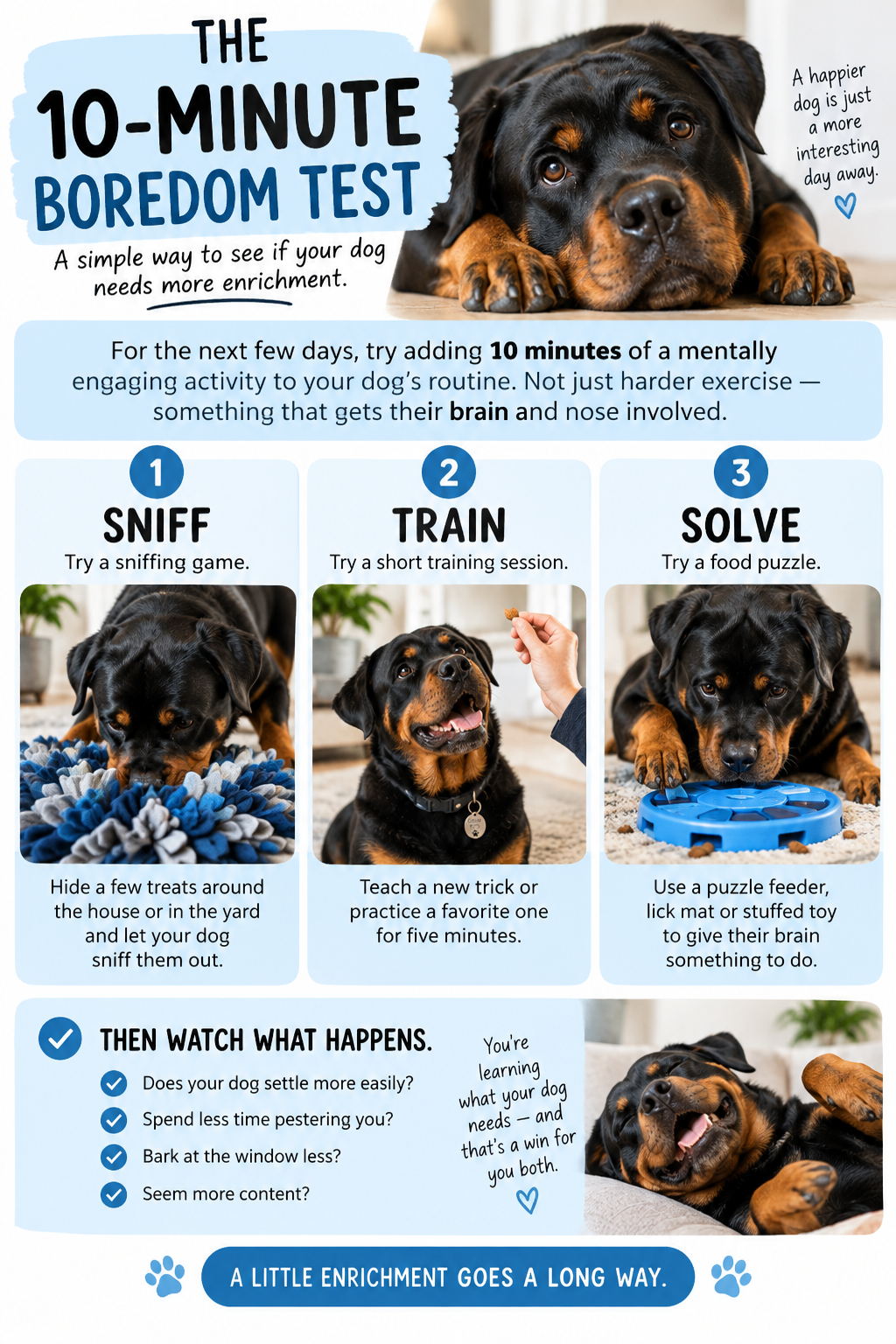
For the next few days, deliberately add 10 minutes of mentally engaging activity to your dog's routine.
Not just harder exercise. Something that gets their brain and nose involved.
Try a sniffing game one day, basic training the next and a food puzzle another day.
Then watch what happens afterward.
Does your dog settle more easily? Spend less time pestering you? Bark at the window less? Seem more content?
You're learning something about what your dog needs.
And that's really the point.
Your Dog Isn't Trying to Give You a Hard Time
It's easy to take frustrating dog behavior personally.
You've told them not to chew the pillow. They chewed it anyway. Clearly they're plotting against you.
Probably not.
Dogs don't come into our homes already understanding which behaviors humans consider acceptable. They're navigating a human world with a dog's instincts, needs and ways of communicating.
Sometimes the answer is training.
Sometimes it's exercise.
Sometimes it's anxiety or another issue that needs professional help.
And sometimes?
Your dog is just bored.
Before you assume you've got a bad dog, give them something better to do.
You might be surprised by what changes.
This article is educational and is not a substitute for veterinary care. If your dog is unwell, contact your veterinarian.