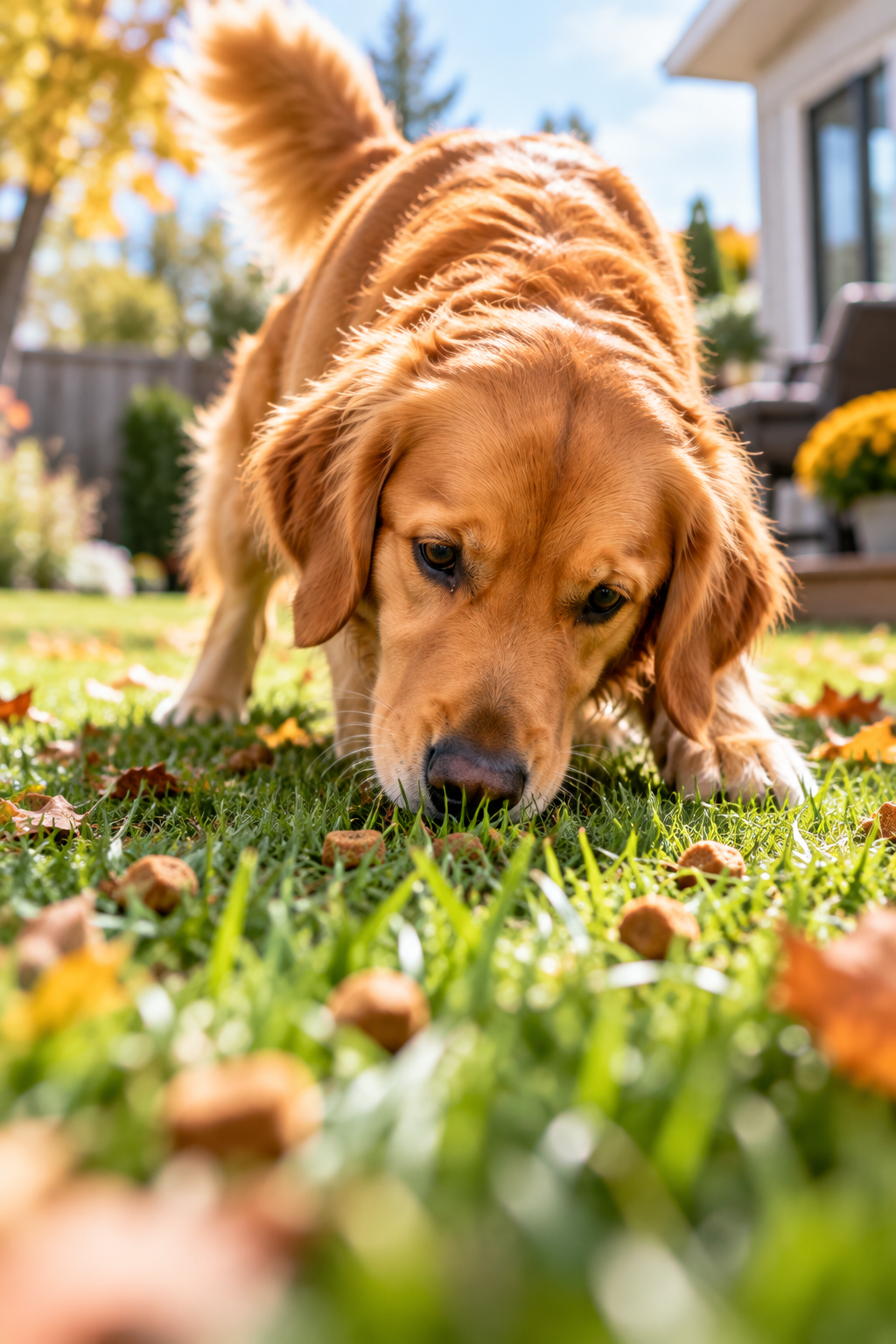
You see a patch of grass.
Your dog sees the neighborhood newspaper.
Who walked through here? How long ago? Was it that golden retriever from three houses down? Has a rabbit committed crimes here recently?
To your dog, sniffing isn't wasting time. It's how they investigate the world.
A dog's nose can pick up an incredible amount of information that we completely miss. That's why giving your dog time to sniff can be such an easy form of mental enrichment.
And here's the best part: you don't need professional scent-work equipment, special training or a living room full of dog puzzles.
You need a few treats, a couple of hiding places and permission for your dog to use that ridiculous nose of theirs.
So instead of constantly saying, "Come on, let's go," the next time your dog stops to sniff something, try something different.
Make sniffing the entire point.
Start ridiculously easy
Grab a treat and let your dog watch you put it on the floor.
Then say:
"Find it!"
Your dog will probably walk directly over and eat it.
Congratulations. Your first scent game lasted approximately four seconds.
But that's exactly what we want.
We're not trying to stump your dog. We're teaching them that "Find it" means there's something out there worth searching for.
Repeat it a few times. Then toss the treat several feet away.
Once your dog hears "Find it" and immediately puts their nose to work, you're ready to make things more interesting.
Breakfast just became a treasure hunt
Instead of putting all of your dog's breakfast into a bowl tomorrow morning, take a portion of their kibble outside.
Scatter it across a small, safe patch of grass.
Then give them the magic words:
"Find it."
And get out of the way.
What normally takes 45 seconds to inhale from a bowl suddenly requires your dog to sniff around and hunt down individual pieces.
No lawn? A clean rug or snuffle mat works too.
Outside, just make sure you're using an area free of lawn treatments, mushrooms, waste or plants you're unsure about.
Now hide a few treats around the house
Once your dog understands the game, move indoors.
Have them wait outside a room while you hide several treats.
For the first round, don't get clever.
Put one beside a chair. Another near the wall. Maybe one next to a table leg.
Then release your dog and say, "Find it!"
Now comes the difficult part.
Not for your dog.
For you.
Shut up and let them work.
It's incredibly tempting to point toward the treat. Or say, "Over here!" Or start giving increasingly obvious hints because you've been watching your dog walk past the same piece of kibble for 45 seconds.
Resist.
Watch what happens instead.
You might see your dog zigzag across the room, suddenly change direction, lift their nose into the air or trace along the edge of furniture.
That's half the fun.
Your dog isn't just finding food anymore.
You're getting to watch their nose work.
Cardboard boxes make surprisingly good puzzles
Got a few shipping boxes lying around?
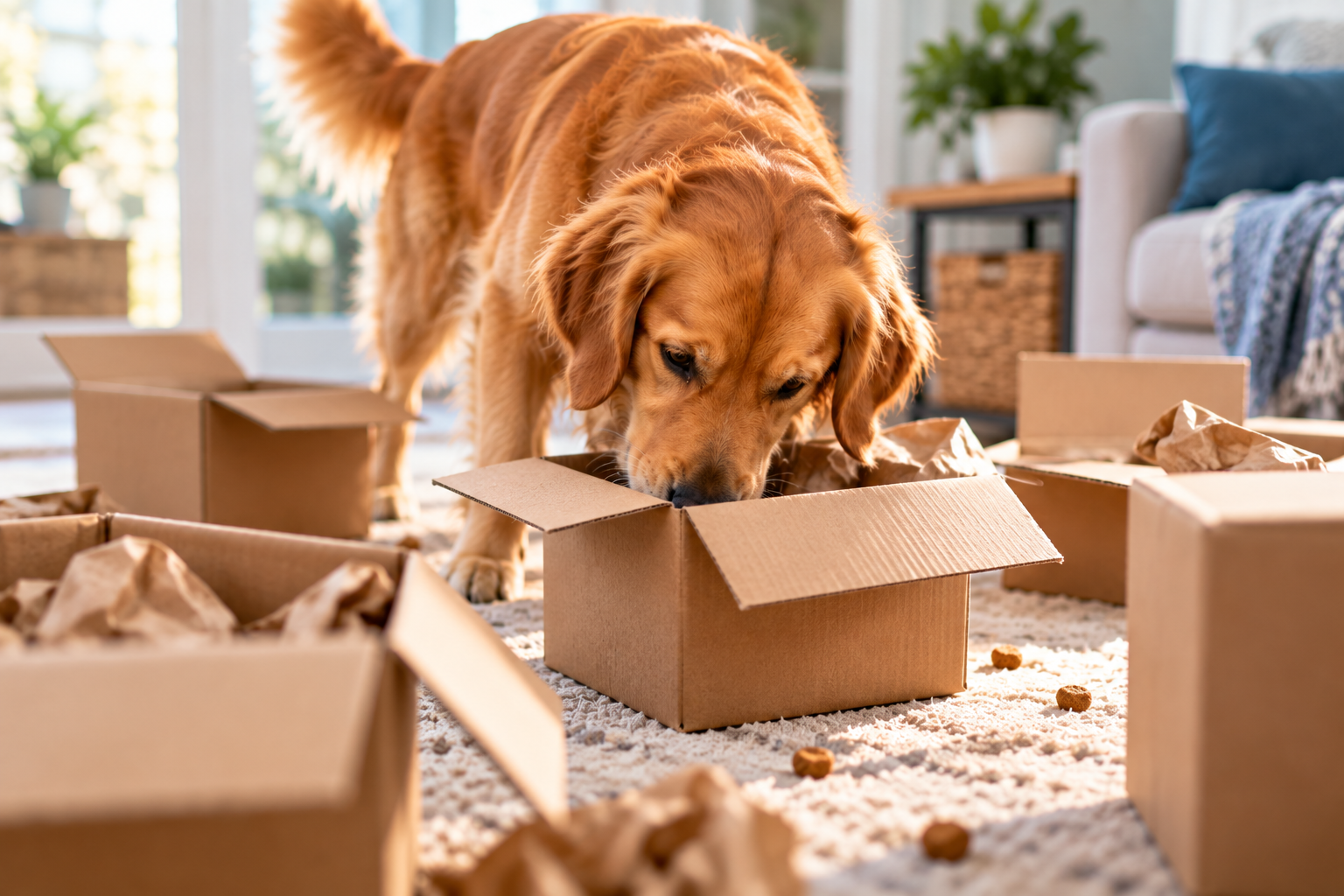
Put four open boxes on the floor and drop a treat or piece of kibble into one.
Let your dog investigate.
Once they understand the game, rearrange the boxes. Add another empty one. Change their positions.
It's an incredibly simple version of a scent search, but something interesting happens:
For once, your dog knows the answer and you don't.
You have to trust their nose.
That's one of our favorite things about scent games. So much of dog training involves us telling the dog what to do.
Scent games flip the arrangement.
You set up the problem.
Your dog becomes the expert.
Just supervise cardboard games if your dog's preferred problem-solving technique is eating the problem.
Food doesn't have to be the prize forever
Treats are fantastic when your dog is learning the game, but eventually you can search for other things.
Grab their favorite ball or toy.
Play with it for a minute so they're interested. Then let your dog watch while you partially hide it behind a chair or underneath the edge of a blanket.
"Find your ball!"
When they discover it, the reward is the game itself.
Play.
Then hide it again.
As your dog improves, make the hiding places a little harder.
You just turned something your dog already loves into a completely different activity.
Then hide a human
This is where scent games get hilarious.
Have someone hold your dog—or ask your dog to wait—while another person hides somewhere in the house.
Start easy.
Behind a door. Around a corner. In another room.
Then release the dog.
When they find the person, celebrate like they just solved a missing-person case that baffled authorities for six months.
Treats. Praise. Play. Ridiculous excitement.
Whatever your dog loves.
This game is especially fun with kids because you're technically enriching two species at once.
Once your dog understands the game, you can try easy hiding places outside in a securely fenced area too.
Leave a trail
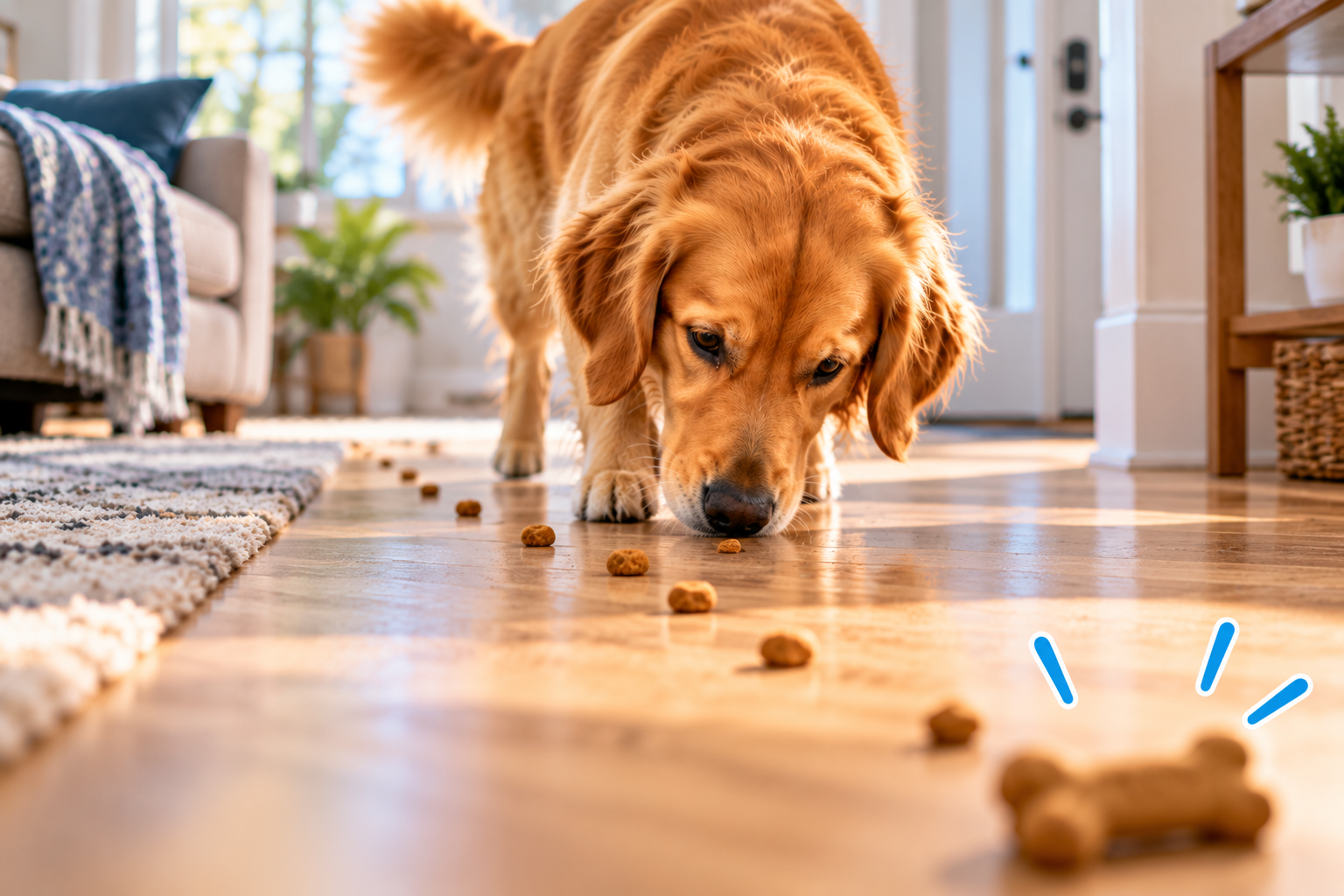
Here's another easy way to make things slightly more challenging.
Place several tiny pieces of food in a short line with a larger reward waiting at the end.
Keep the pieces close together at first.
As your dog gets better, increase the distance between them. Eventually, add a gentle turn.
Now your dog isn't simply searching for individual pieces of food.
They're beginning to follow where the scent leads.
Again, don't rush it.
Watching your dog succeed at an easy search is much more useful than watching them get frustrated by an "advanced" one.
Try the mystery-container game
Once your dog is confidently searching, you can experiment with a simple choice game.
Take several identical, dog-safe containers with ventilation holes. Put food inside one and leave the others empty.
Let your dog sniff each one.
When they clearly show interest in the correct container, reward them.
Maybe they stare at it. Maybe they nose it. Maybe they sit beside it.
The exact signal matters less than giving your dog the chance to investigate and make a decision.
If the containers immediately become chew toys, abandon the experiment and return to open boxes.
We know when we've been defeated.
Change the scenery
Once your dog becomes a household scent-searching champion, take the game somewhere different.
Try the backyard.
A friend's securely fenced yard.
A quiet room your dog hasn't searched before.
You'll probably notice something interesting.
A game that's ridiculously easy in your living room may suddenly become much harder somewhere else.
That's because your dog isn't working in an empty scent environment. There are other dogs, people, food, plants and approximately 700 other smells competing for attention.
So when you make the environment harder, make the search easier.
Give your dog a chance to figure things out.
Start watching the dog instead of the hiding place
This might be the coolest part of scent games.
Eventually, stop staring at wherever you hid the treat.
Watch your dog.
What happens when they catch the scent?
Do they suddenly turn?
Speed up?
Slow down?
Put their nose to the floor?
Lift their head?
Double back?
Look at you?
Every dog has their own little tells.
And suddenly scent games aren't only teaching your dog something.
They're teaching you how to read your dog.
That's a pretty cool thing to get from a handful of kibble.
Don't accidentally make the game harder than it needs to be
The biggest mistake is helping too much.
Give your dog time to figure things out. If they're genuinely stuck, don't point to the answer. Make the next search easier.
Success builds confidence.
And don't assume harder automatically means better enrichment.
Five easy finds that keep your dog happily searching can be much more valuable than one impossible hiding place that ends with your dog staring at you like you're an idiot.
You also don't need to make every search about food. Once your dog understands the concept, toys and people can join the game.
And there's no reason to start experimenting with essential oils, household chemicals or random scented products. Formal scent sports have specific target odors and procedures. For casual enrichment at home, familiar food, toys and people give you plenty to work with.
Scent games can also be adapted for puppies, adult dogs and seniors. Just adjust the size of the search area, hiding locations and physical demands to match your dog.
Your regular walk can be a scent game too
Here's perhaps the easiest version of all.
Pick one walk where you're not trying to set a land-speed record.
Go somewhere safe.
And let your dog sniff.
That's it.
If they want to spend 45 seconds investigating a telephone pole, let them.
If they become fascinated by one bush, give them a minute.
Let them choose the direction occasionally when it's safe and practical.
You might cover considerably less distance than usual.
That's okay.
There's a time for structured walking and getting some exercise.
There's also a time for standing beside a bush while your dog conducts what appears to be a full forensic investigation.
Both walks can have value.
The Bark Clinic Bottom Line
We spend a lot of time asking dogs to participate in our world.
Walk at our speed.
Follow our route.
Ignore that smell.
Leave that thing alone.
Keep moving.
Scent games give them a chance to flip the script.
You create the problem.
Your dog gets to be the expert.
You don't need special equipment. You don't need an elaborate setup. And you definitely don't need to turn your living room into a professional scent-work facility.
Start with one treat sitting ridiculously obviously on the floor.
Say "Find it."
Then resist every human instinct you have to help.
Your dog's nose can take it from there.
This article is educational and is not a substitute for veterinary care. If your dog is unwell, contact your veterinarian.