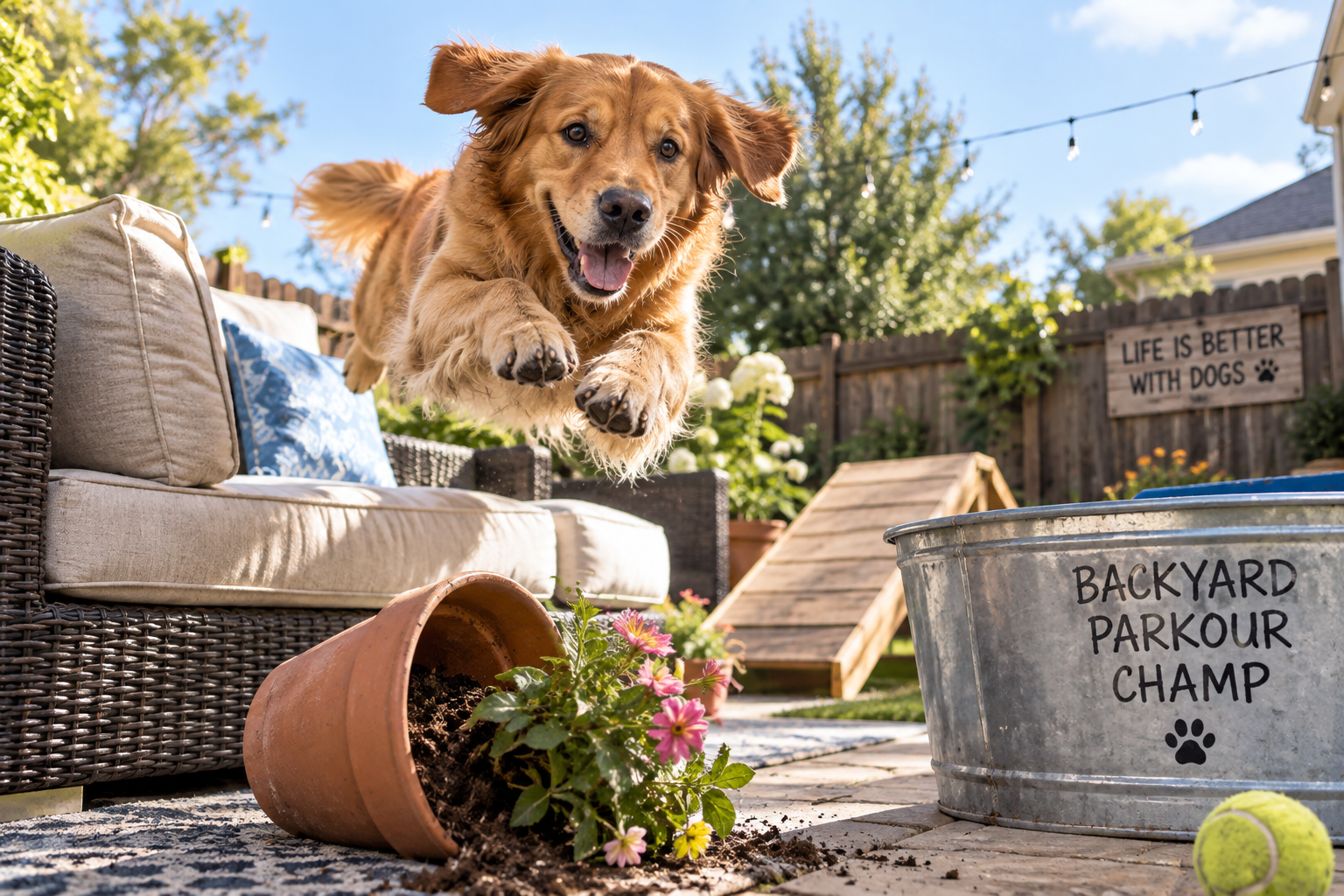
One minute your dog is sprinting across the yard like they've just qualified for the Olympics. Or, digging up the yard despite your best efforts to urge them to stop.
The next?
They're hobbling toward you on three legs looking like they'll never walk again.
Welcome to dog ownership.
A limp can happen for all kinds of reasons. Sometimes it's something surprisingly small, like a burr stuck between the toes or a sore paw pad. Other times, limping can be a sign of an injury or joint problem that needs veterinary attention.
The good news is that you don't need to figure out exactly what's wrong with your dog's leg.
Your first job is much simpler:
Take a look, keep them from making it worse, and decide how quickly they need veterinary care.
Start With the Paw
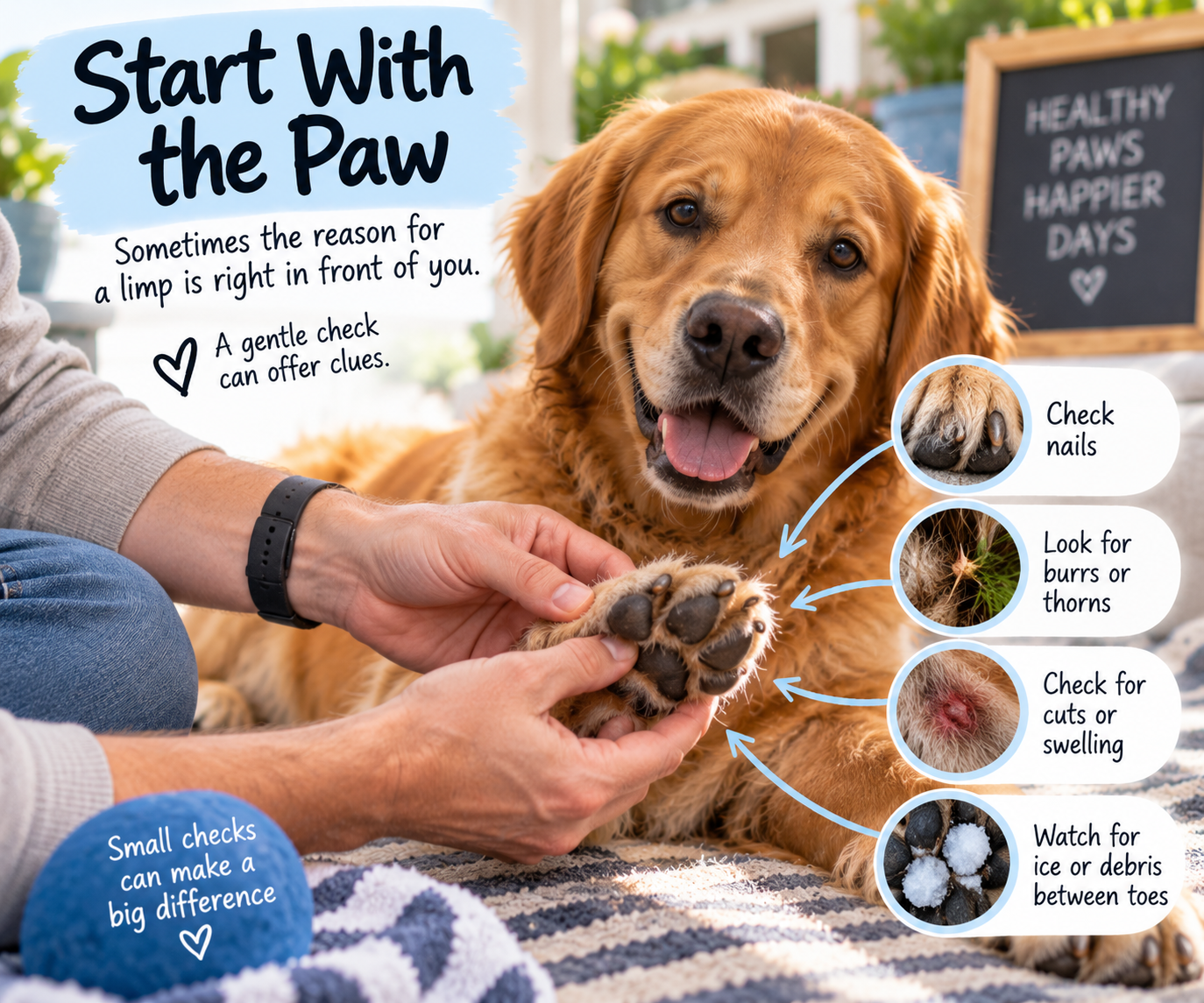
If your dog is comfortable letting you look, start with the obvious stuff.
Check the paw pads, between the toes, and around each nail.
You're looking for things like:
A torn or broken nail
A cut or scrape
Swelling
A thorn or splinter
Burrs or other debris
Ice or snow packed between the toes
Something visibly stuck in the paw
It can also help to compare the sore leg or paw with the same area on the opposite side. Sometimes swelling or another change is much easier to notice when you have a normal leg for comparison.
But this isn't the time to turn into a home orthopedic surgeon.
Don't repeatedly bend joints, squeeze the leg, or keep poking around trying to find exactly where it hurts.
Even the sweetest dog can react differently when they're frightened or in pain. If your dog seems uncomfortable with your inspection, stop.
Give the Zoomies a Day Off
If your dog has a mild limp after a long walk, enthusiastic game of fetch, or particularly ambitious round of backyard nonsense—but otherwise seems comfortable—reducing their activity is a sensible first step while you contact your veterinarian for guidance.
That means temporarily avoiding:
Running.
Jumping.
Wrestling with another dog.
Launching themselves off the couch.
And whatever questionable athletic event they invented five minutes ago.
Keep bathroom breaks calm and on a leash.
Leash walks aren't nearly as exciting as backyard parkour. That's exactly the point.
Rest gives a minor strain or sore paw a chance to settle down and helps prevent your dog from turning a small problem into a bigger one.
Don't Reach Into Your Medicine Cabinet
Watching your dog limp makes you want to help them feel better.
But don't give your dog human pain medication unless your veterinarian specifically tells you to.
Medications that seem completely ordinary to us can be dangerous for dogs, and some can complicate veterinary treatment.
If you think your dog is painful enough to need medication, that's a good reason to call your veterinarian and ask what they recommend. Don’t hesitate to call a 24/7 veterinarian emergency line if the injury happens after hours.
When a Limp Shouldn't Wait
Not every limp is an emergency.
But some definitely deserve faster attention.
Seek prompt veterinary care if:
Your dog can't put any weight on the leg
The leg looks bent, deformed, or positioned strangely
There was significant trauma, such as being hit by a vehicle or taking a serious fall
Your dog appears to be in severe pain
There's significant bleeding that won't stop
The limb suddenly becomes very swollen
The pain or limping is rapidly getting worse
Your dog is also weak, lethargic, or otherwise seems sick
And then there's the limp that's not dramatic—but just won't go away.
That deserves attention, too.
Dogs are remarkably good at compensating for discomfort. If you keep noticing the same limp after long walks, vigorous play, or getting up from a nap, don't automatically write it off because your dog seems fine the rest of the time.
A recurring limp can still be your dog's way of telling you something hurts.
Before the Vet Visit, Grab Your Phone
There is a strange phenomenon familiar to dog owners everywhere.
Your dog limps around the house all morning.
You schedule an appointment.
You arrive at the veterinary clinic.
And suddenly…
They're cured.
Walking perfectly normally.
Possibly even bouncing around the exam room while you desperately explain, “I swear he was limping five minutes ago.”
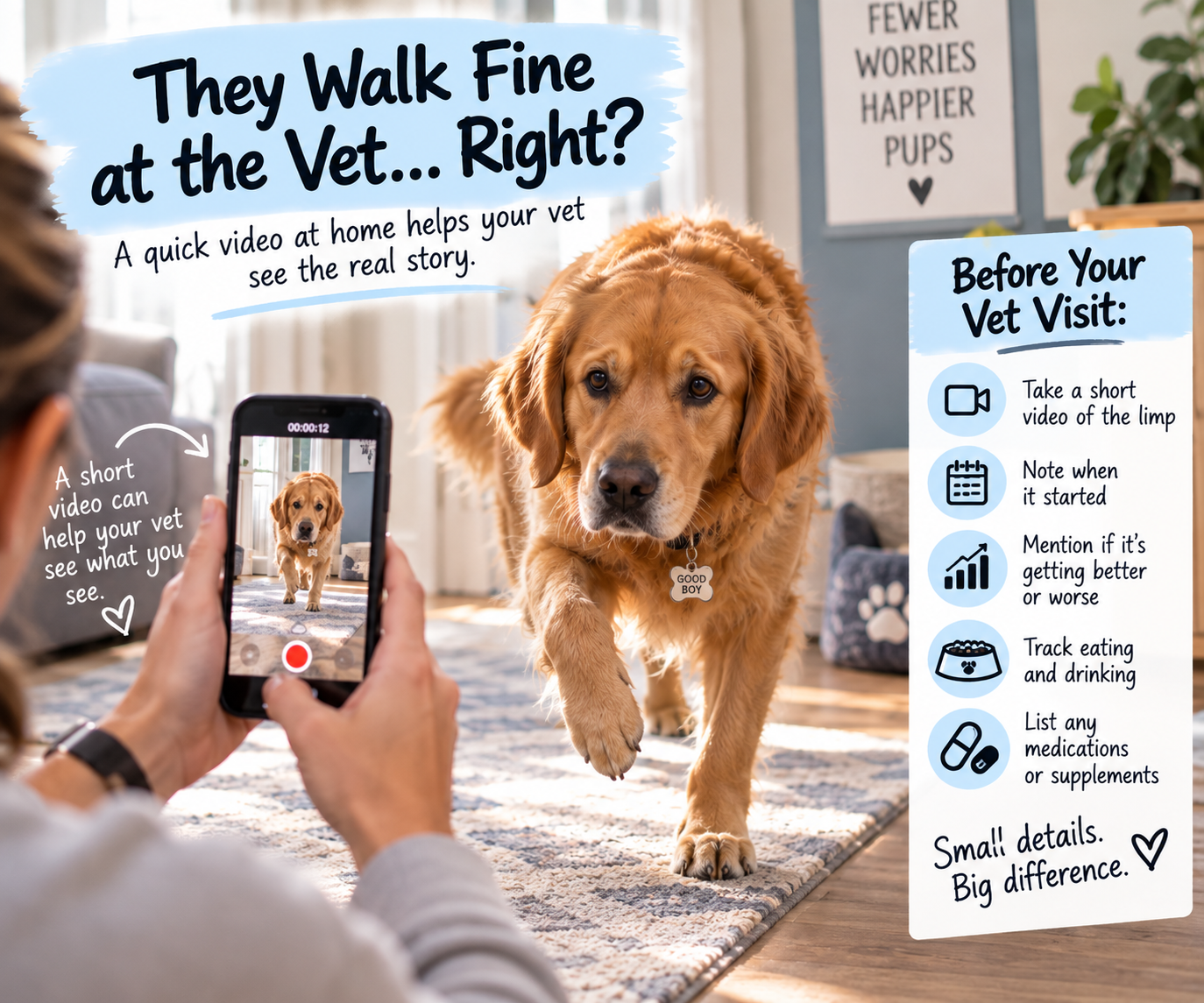
This is why your phone can be incredibly useful.
If you can do it without encouraging unnecessary movement, record a short video of your dog walking naturally at home.
Try getting a view from the side, front, and behind.
That gives your veterinarian a chance to see what you were seeing—even if your dog decides to perform a miraculous recovery in the parking lot.
The Bark Clinic Takeaway
You don't need to identify which muscle, tendon, ligament, joint, or toe is causing your dog's limp.
That's not your job.
Your job is to notice the change.
Check for obvious paw problems. Keep your dog from overdoing it. Don't experiment with human pain medications. And get veterinary help when the limp is severe, worsening, persistent, or keeps coming back.
Because sometimes a limp really is just the result of an overly enthusiastic afternoon.
And sometimes it's your dog's quiet way of saying:
“Hey. Something hurts.”
Knowing the difference starts with paying attention.
This article is educational and is not a substitute for veterinary care. If your dog is unwell, contact your veterinarian.