Most dog first aid kits have one thing in common:
You buy them, stick them in a closet and hope you never have to open them.
That’s actually the best-case scenario.
But if your dog slices a paw on a walk, gets something stuck between their toes or somehow turns an ordinary Saturday afternoon into an emergency, that’s a terrible time to discover your “complete 87-piece pet first aid kit” contains 42 tiny bandages and nothing you actually know how to use.
A good dog first aid kit doesn’t need to be enormous.
It needs to contain a small collection of useful supplies you understand, along with the information you’ll need if the situation is more serious than you can handle at home.
Here’s what we’d put in ours.
First: A Dog First Aid Kit Isn’t a Tiny Veterinary Hospital
This distinction matters.
Your first aid kit is meant to help you manage minor injuries, protect an injury while getting veterinary care or handle the first few minutes of an emergency.
It isn’t supposed to turn you into your dog’s veterinarian.
You don’t need surgical equipment.
You don’t need a pharmacy.
And you definitely don’t need a collection of internet remedies that somebody’s cousin swears worked on their Labrador in 2009.
Think of your kit as a bridge between:
“Something happened.”
and
“Here’s what we’re doing next.”
Sometimes that next step is cleaning and covering a minor scrape.
Sometimes it’s driving directly to an emergency vet.
A useful kit helps with both.
What Should Be in a Dog First Aid Kit?
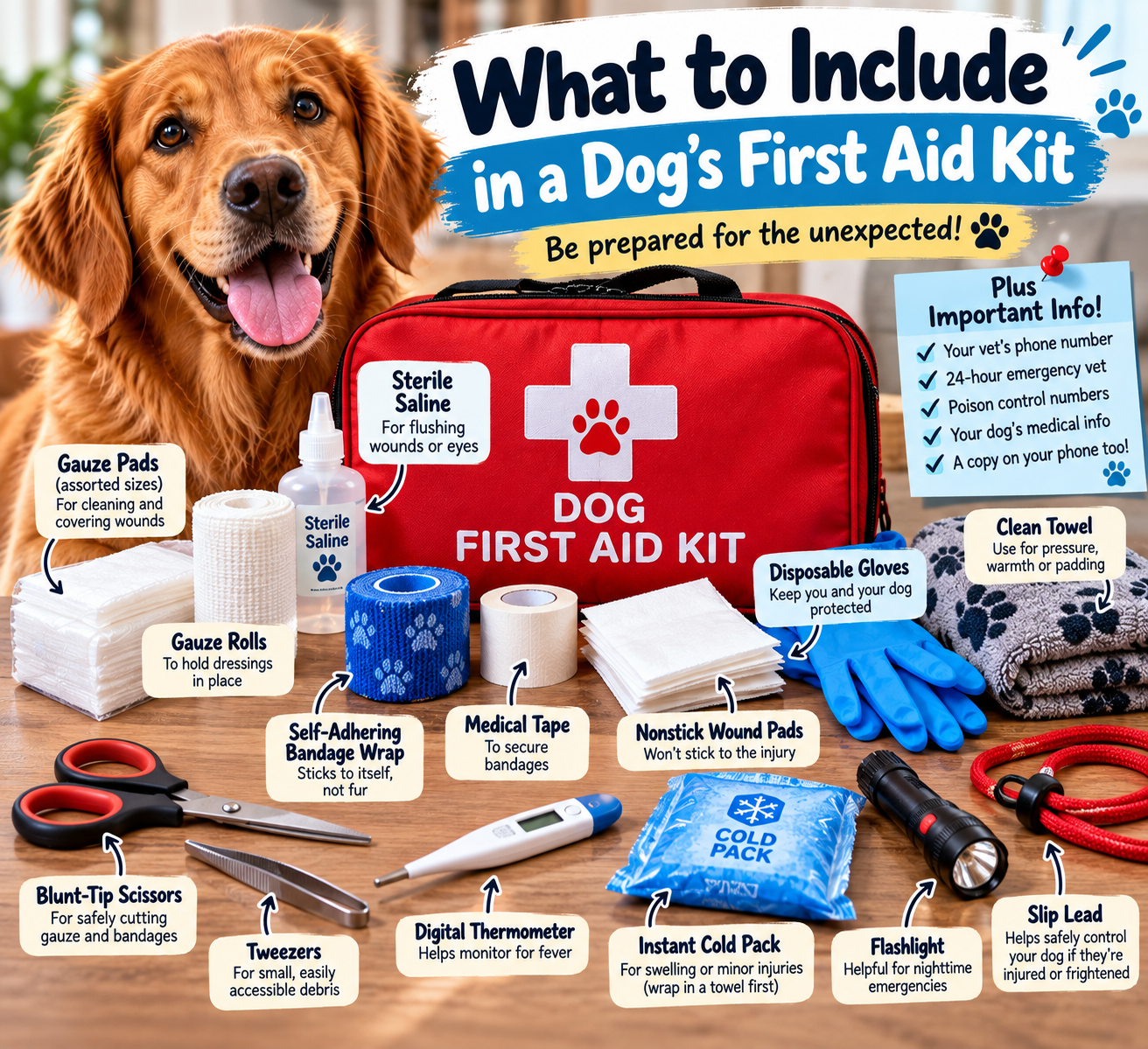
You can buy a premade pet first aid kit and improve it, or build your own.
Either way, we’d start with these basics.
Gauze Pads and Gauze Rolls
If there’s one thing worth having plenty of, it’s gauze.
Sterile gauze pads can help cover wounds, while rolled gauze can help hold dressings in place.
They’re lightweight, inexpensive and useful for everything from a damaged paw pad to protecting a wound during the ride to the veterinarian.
Pack several sizes rather than one giant roll.
Nonstick Wound Pads
Nobody wants to pull dried gauze off a sore wound.
Nonstick sterile pads provide a layer between the injury and whatever you’re using to secure the dressing.
They’re particularly useful for abrasions, cuts and damaged paw pads.
Self-Adhering Bandage Wrap
This is the stretchy wrap that sticks to itself rather than your dog’s fur.
It’s incredibly useful.
It’s also something you can accidentally apply too tightly.
Bandages that restrict circulation can cause additional injury, so wrapping tighter isn’t better. If you don’t know how to properly bandage an injury, use your supplies to protect the area temporarily and get veterinary guidance.
Adhesive Medical Tape
Useful for securing dressings and bandages.
A small roll is plenty for most home kits.
Blunt-Tip Scissors
Trying to cut gauze with the kitchen scissors while your dog is moving around is not an experience we recommend.
Keep a dedicated pair of blunt-tip scissors in the kit.
The rounded end makes them safer to use around an animal who’s probably not thrilled about whatever you’re doing.
Disposable Gloves
First aid can get messy.
A few pairs of disposable gloves help protect both you and your dog while you’re dealing with blood, drainage or other bodily fluids.
Pack more than one pair.
They’re tiny.
Sterile Saline
Sterile saline can be useful for gently flushing debris from wounds or rinsing an eye while you’re seeking veterinary guidance.
Small individual containers are convenient because you don’t have to worry about an opened bottle sitting around forever.
Check expiration dates periodically.
Tweezers
A simple pair of tweezers can help with small, easily accessible debris.
Think splinters or something sitting superficially in the fur.
They aren’t an invitation to perform minor surgery at the kitchen table.
If something is deeply embedded, painful to remove or located near the eye, mouth or another sensitive area, leave it alone and call your veterinarian.
A Digital Thermometer
This one makes people hesitate.
Yes, taking a dog’s temperature at home isn’t exactly anybody’s favorite bonding activity.
But body temperature can provide useful information during an illness or emergency.
A normal dog’s rectal temperature is generally around 100–102.5°F, although context matters.
Keep a digital thermometer specifically for your dog, clearly label it and include a small amount of water-based lubricant.
If you’ve never taken your dog’s temperature before, ask your veterinarian to show you how during a routine visit rather than learning during an emergency.
A Clean Towel
One of the most useful pieces of dog first aid equipment might already be in your bathroom.
A clean towel can help:
Apply pressure to bleeding
Protect an injured area
Keep a wet or chilled dog warm
Provide padding during transport
Help handle a frightened animal
If you have room, include one.
An old clean bath towel works perfectly.
An Instant Cold Pack
A cold pack can be useful for some minor injuries and swelling while you’re contacting your veterinarian.
Wrap it in cloth before placing it against your dog’s skin.
Don’t leave it directly against the skin for extended periods.
A Flashlight
Because apparently dogs prefer emergencies to happen somewhere with terrible lighting.
A small flashlight can help you inspect paws, look around the mouth or see an injury more clearly.
Don’t rely entirely on your phone.
Your phone is also the thing you’ll need to make calls, navigate to the emergency vet and possibly photograph whatever your dog just got into.
A Slip Lead
This is one of our favorite additions because people don’t always think of it as first aid equipment.
A frightened or injured dog may behave differently than usual.
A slip lead can help you safely move or control a dog even if their normal collar or harness isn’t available.
Keep one in your home kit and another in your vehicle.
The Most Important Thing in Your Kit Isn’t Medical Equipment
It’s information.
Seriously.
You can have the world’s greatest collection of gauze, but it’s not much help when you’re frantically Googling “emergency vet near me” at 1:13 a.m.
Put an emergency information card inside your kit.
Include:
Your regular veterinarian:
Name and phone number
Nearest 24-hour emergency veterinary hospital:
Name, phone number and address
ASPCA Animal Poison Control Center:
888-426-4435
Pet Poison Helpline:
855-764-7661
You should also include your dog’s:
Name
Approximate weight
Age
Known medical conditions
Current medications
Allergies, if applicable
Then take a picture of the card and save it on your phone.
Because the first aid kit might be at home when the emergency happens somewhere else.
What About Hydrogen Peroxide?
This is where dog first aid kits get tricky.
You’ll sometimes see hydrogen peroxide recommended as something every dog owner should keep around in case a dog eats something toxic.
We wouldn’t treat it as a universal first aid item.
Veterinary professionals sometimes recommend inducing vomiting in specific poisoning situations, but making a dog vomit isn’t appropriate for every substance or every dog.
In some situations, vomiting can actually make things worse.
So don’t automatically reach for hydrogen peroxide because your dog swallowed something suspicious.
Call your veterinarian or an animal poison-control service first.
If they determine vomiting is appropriate, follow their instructions exactly.
What Shouldn’t You Put in a Dog First Aid Kit?
This might be more important than the shopping list.
A dog first aid kit shouldn’t become a collection of things you plan to administer without veterinary guidance.
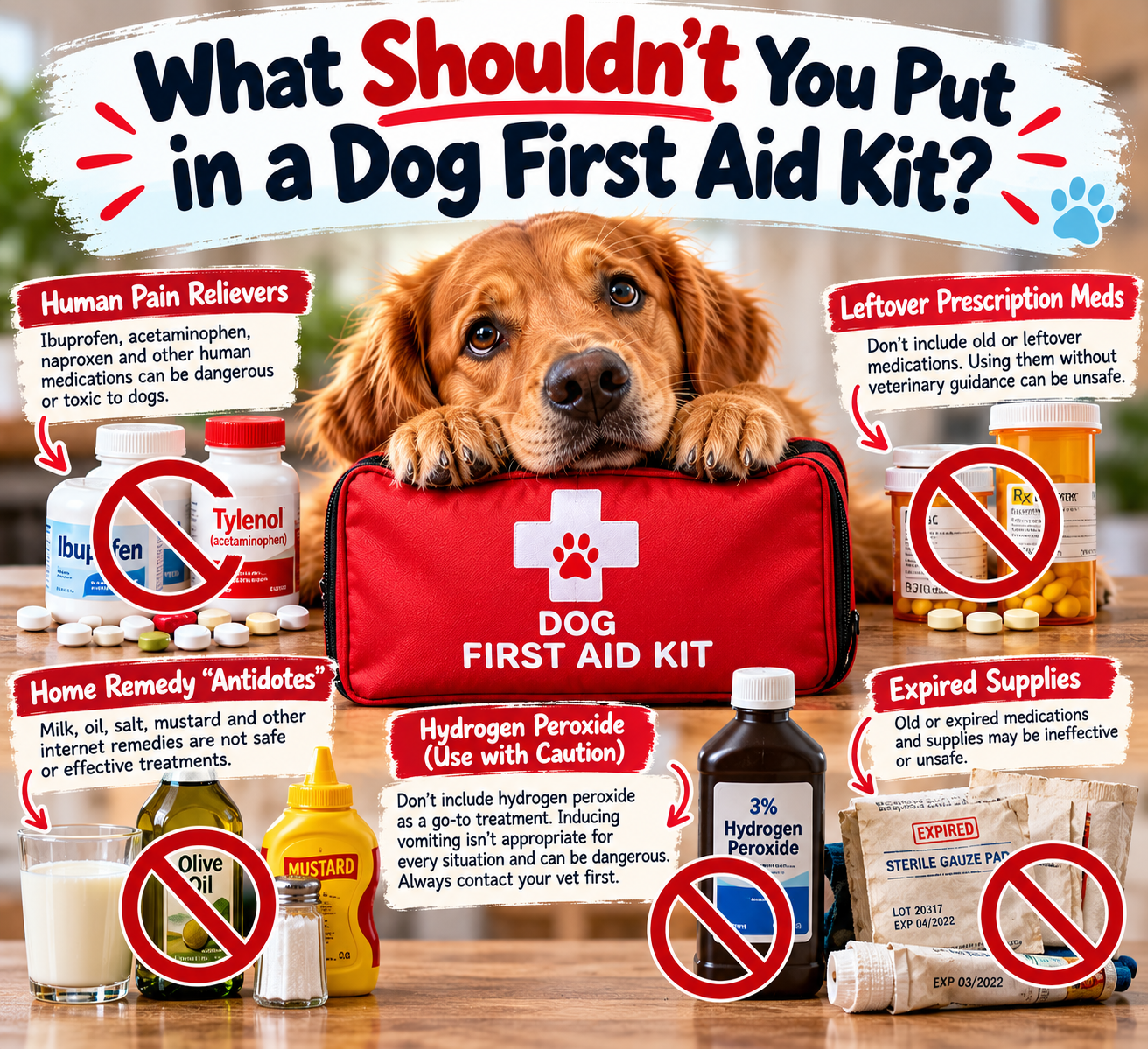
Human Pain Relievers
Don’t stock ibuprofen, naproxen or acetaminophen as DIY pain medication for your dog.
Human medications can be dangerous or toxic to dogs.
Pain management belongs in the veterinarian category.
Random Leftover Prescription Medications
Have three antibiotic tablets left over from your dog’s ear infection two years ago?
Those don’t belong in your emergency kit.
Using old medications for a new problem can delay appropriate treatment or create additional problems.
Home-Remedy “Antidotes”
Milk.
Oil.
Salt.
Mustard.
Whatever somebody on social media says “absorbs toxins.”
Skip it.
Poisoning treatment depends on what your dog swallowed, how much they swallowed, their weight, how long ago it happened and their current condition.
There isn’t one kitchen-cabinet antidote that fixes everything.
Expired Supplies
A first aid kit you haven’t opened in four years might not be as prepared as you think.
Saline expires.
Medications expire.
Packaging gets damaged.
Adhesives deteriorate.
Once or twice a year, open the kit and inspect everything.
Build a Dog First Aid Kit for the Car Too
If your dog regularly travels with you, we’d make a second smaller kit.
You don’t need to duplicate absolutely everything.
A simple car kit could contain:
Gauze
Nonstick pads
Self-adhering wrap
Medical tape
Gloves
Saline
Blunt-tip scissors
Tweezers
Clean towel
Slip lead
Emergency contact information
Add bottled water and a collapsible bowl to your regular travel supplies.
And don’t bury the kit underneath six suitcases and a cooler.
If you need it, you need to be able to reach it.
What About Hiking and Camping?
This is where we’d modify the kit rather than simply making it bigger.
If you’re several miles from your vehicle, portability matters.
Focus on supplies that can stabilize a minor injury or help you safely get your dog back to transportation.
Bring wound-care supplies, a leash, water, emergency contact information and anything specific to your dog’s known medical needs.
Most importantly, know where the nearest veterinary clinic is before you disappear into an area with questionable cell service.
That’s boring preparation right up until the moment it isn’t.
What Do You Do If Your Dog Is Bleeding?
First, stay as calm as you can.
Dogs notice when we’re panicking, and an injured dog may already be frightened.
For external bleeding, a clean cloth or gauze can be used to apply firm, direct pressure to the area while you seek veterinary guidance.
Avoid repeatedly lifting the material to see whether the bleeding stopped.
If blood soaks through, additional material can generally be placed over the existing layer while maintaining pressure.
Significant or uncontrolled bleeding requires emergency veterinary care.
And remember that even the sweetest dog in the world may bite when they’re frightened or in pain.
Protect yourself too.
What If My Dog Cuts Their Paw?
Paw injuries are one of those things that can look like a crime scene.
Dogs walk on their feet constantly, and paw pads have a healthy blood supply.
If your dog injures a paw:
Move them somewhere safe.
Look for obvious debris.
Apply gentle direct pressure if it’s bleeding.
Rinse superficial dirt with sterile saline if appropriate.
Protect the paw from further contamination.
Contact your veterinarian if the wound is deep, continues bleeding, contains an embedded object or causes significant pain or lameness.
Don’t assume a deep paw-pad cut will heal normally just because your dog can still walk.
Dogs can be remarkably committed to pretending everything is fine.
What If Something Gets in My Dog’s Eye?
Don’t start digging around.
Eyes are delicate, and an injury can worsen quickly.
Sterile saline may be useful for gently flushing loose irritants from the eye.
But if your dog is squinting, pawing at their eye, keeping it closed, showing significant redness or has something embedded in or around the eye, contact your veterinarian promptly.
Eye problems are not good “let’s see how it looks tomorrow” problems.
What If My Dog Is Choking?
Choking is an emergency.
If your dog cannot breathe, is becoming unconscious or has blue or gray gums, they need immediate help.
If you can clearly see a loose object in the mouth and can safely remove it without pushing it farther down the throat, you may be able to do so.
Don’t blindly sweep your fingers deep into your dog’s mouth.
And don’t lose valuable time repeatedly attempting to remove an object you can’t reach.
Contact an emergency veterinary hospital and begin traveling there as quickly as possible.
Your First Aid Kit Needs One More Thing: A Plan
Imagine this:
It’s 10:30 on a Sunday night.
Your dog is bleeding.
Your regular veterinarian is closed.
Do you know where you’re going?
Not “I can Google it.”
Do you actually know?
Find your closest 24-hour emergency veterinary hospital now.
Check its hours.
Save the phone number.
Save the address.
Then find a backup.
Emergency clinics can be busy, temporarily divert patients or change hours.
Having Plan B already saved is much easier than figuring it out with an injured dog in the back seat.
The Bark Clinic Dog First Aid Kit Checklist
Here’s the version we’d screenshot:
WOUND CARE
Sterile gauze pads
Rolled gauze
Nonstick wound pads
Self-adhering bandage wrap
Medical tape
Sterile saline
TOOLS
Blunt-tip scissors
Tweezers
Digital thermometer
Flashlight
Disposable gloves
EXTRAS
Clean towel
Instant cold pack
Slip lead
Water-based lubricant for thermometer
Emergency information card
ON YOUR PHONE
Regular veterinarian
Emergency veterinarian
Backup emergency clinic
Animal poison-control numbers
Dog’s current medications and medical information
That’s enough to make a genuinely useful kit without turning your hall closet into a veterinary supply warehouse.
Frequently Asked Questions
What should every dog first aid kit contain?
At minimum, keep basic wound-care supplies such as gauze, nonstick pads, self-adhering wrap, medical tape, sterile saline and disposable gloves, along with blunt-tip scissors, tweezers, a thermometer and your emergency veterinary contact information.
Can I use a human first aid kit for my dog?
Some supplies overlap, including gauze, gloves and medical tape. However, human kits may contain medications or products that aren’t appropriate for dogs. A dog-specific kit also benefits from items such as a slip lead and your pet’s veterinary information.
Should I keep hydrogen peroxide in my dog’s first aid kit?
Don’t rely on hydrogen peroxide as an automatic treatment for poisoning. Inducing vomiting can be inappropriate or dangerous in some situations. Contact your veterinarian or animal poison-control service before attempting to make your dog vomit.
Can I give my dog human pain medication in an emergency?
Don’t give your dog human pain relievers unless a veterinarian specifically instructs you to. Common human medications can be dangerous to dogs.
Where should I keep my dog’s first aid kit?
Keep your primary kit somewhere easy to reach at home—not buried behind holiday decorations. If your dog travels regularly, keep a smaller second kit in your vehicle or travel bag.
How often should I replace dog first aid supplies?
Inspect the kit at least once or twice a year and after every use. Replace expired, opened, damaged or depleted supplies.
The Bark Clinic Bottom Line
Building a dog first aid kit isn’t about preparing for every bizarre thing your dog could possibly do.
We’d need a much bigger bag for that.
It’s about being ready for the first few minutes.
You need enough supplies to clean or protect a minor injury, control bleeding while seeking help, safely transport your dog and quickly reach the people who know what to do next.
So build the kit.
Save the emergency numbers.
Throw a smaller version in the car.
And then hopefully forget the thing exists for the next ten years.
Because the best dog first aid kit is still the one you never have to use.
This article is educational and is not a substitute for veterinary care. If your dog is unwell, contact your veterinarian.
Keep reading

My Dog Ate Something They Shouldn’t: What to Do in the First 10 Minutes
Did your dog eat something they shouldn’t? Here’s what to do in the first few minutes, what information to gather, what not to try at home, and when to seek emergency veterinary help.
Read article
Does My Dog Need Stitches? What to Do When Your Dog Gets Cut
Your dog got cut, there’s blood, and now you’re wondering whether this is a clean-it-at-home situation or a trip to the vet. Here’s how to make that decision without panicking.
Read article
The 10-Minute Fall Backyard Dog Safety Check
Closing up the backyard for fall? Take 10 minutes to walk through it from your dog’s point of view and catch the things hiding under furniture, behind planters and around the yard before your dog does
Read article