Before you put away the patio furniture and call the backyard finished for the season, take one quick walk around it—from your dog’s point of view.
Fall cleanup has a funny way of revealing things.
You move the patio couch and discover three tennis balls, 400 leaves, a spider that now legally owns the property and something your dog immediately wants to eat.
Naturally, the dog finds that last thing first.
That’s why before you stack the chairs, roll up the outdoor rug and shove everything into the garage until April, we’re proposing a new fall tradition:
The 10-Minute Bark Clinic Backyard Check.
No hazmat suit required.
We’re simply going to walk through the backyard one area at a time and ask one very useful question:
“What can my dog reach, lick, chew, step on or swallow?”
Ready?
Grab your dog.
Actually…
Maybe leave the dog inside for this part.
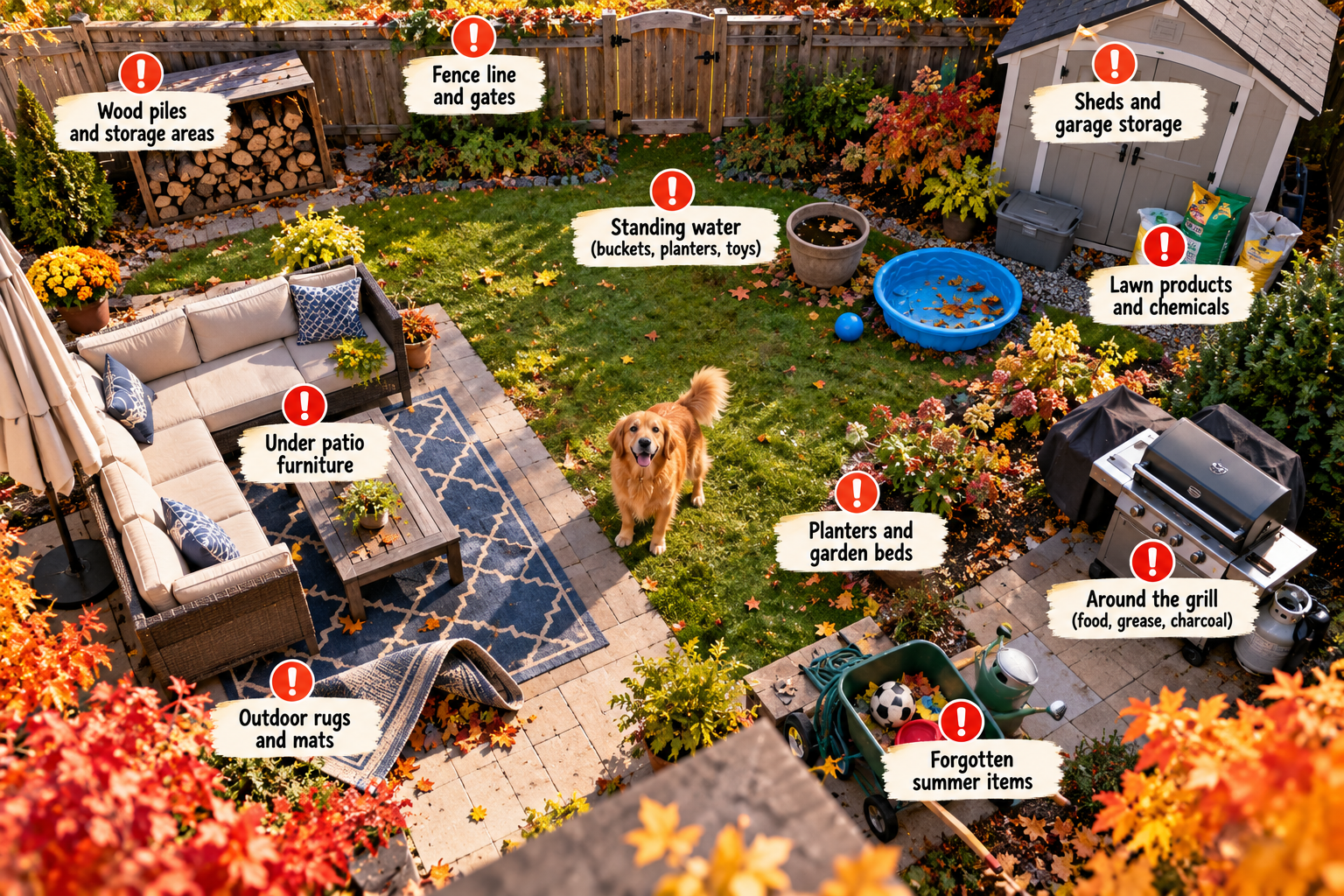
Stop #1: Under the Patio Furniture
Let’s begin where our Pinterest Pin left you hanging.
Move the chairs.
Slide the outdoor couch.
Pick up the cushions.
Look underneath the table.
You’re searching for anything that’s been quietly accumulating where you haven’t looked since Memorial Day.
That might include old food, dropped wrappers, chewed toy pieces, forgotten pest-control products, sharp debris or other mystery objects.
And remember: something being gross enough that you wouldn’t eat it has never been a particularly effective dog-safety strategy.
✓ The Patio Check
□ Move the furniture
□ Pick up old food and trash
□ Remove broken toy pieces
□ Check for sharp debris
□ Look for anything your dog could swallow
One area down.
Stop #2: Lift the Outdoor Rug
If you have an outdoor rug, mat or anything else that’s been sitting against the ground all summer, pick it up.
We’re looking for moisture, debris and anything that has made itself comfortable underneath.
This is also a good time to inspect the rug itself. Fraying edges and loose material can become extremely interesting to dogs who believe every object in their home must first pass a taste test.
Shake it out.
Inspect underneath it.
Then decide whether it’s ready for storage—or whether Mother Nature has already started composting it for you.
Stop #3: Check Around the Planters
Here’s where we slow down.
Look around your pots, flower beds and damp areas for wild mushrooms.
Mushrooms can appear quickly, especially during wet weather. Many wild mushrooms cause little or no toxicity, but some can cause serious or even life-threatening poisoning—and telling them apart isn’t always easy.
ASPCA Poison Control recommends preventing dogs from eating wild mushrooms and contacting a veterinarian or poison-control expert if an ingestion occurs.
So our Bark Clinic mushroom-identification system is extremely sophisticated:
Random mushroom + dog = don’t let them eat it.
If you find one, remove it where your dog can’t access it rather than assuming it’s safe based on an image search.
Got a compost pile? Check that too. Rotting food smells considerably more appealing to your dog than it does to you. Compost can contain foods dogs shouldn’t eat, and moldy material can create additional risks. Keep your dog from digging through it and make sure the bin or pile is secured.
✓ The Garden Check
□ Look for newly appeared mushrooms
□ Pick up fallen or rotting plant material
□ Check beneath and behind planters
□ Remove unfamiliar things your dog might eat
□ Keep unknown plants and fungi out of reach
And while you’re standing there…
Stop #4: Remember What You Put on the Lawn
This one is easy to overlook because the product may have been applied days or weeks ago.
Think back.
Did you use fertilizer?
Weed killer?
Insecticide?
Slug or snail bait?
Rodent bait?
Something labeled “natural” that you assumed automatically meant dog-safe?
Products vary enormously, which is why the actual product label matters more than blanket internet rules. ASPCA advises following label directions for lawn products and keeping pets away for the specified period.
Some fertilizers containing ingredients such as bone meal or blood meal may also be particularly attractive to dogs, and large ingestions can cause serious problems.
So don’t just inspect the lawn.
Inspect the storage area too.
A half-used bag sitting open at dog height in the shed isn’t magically safer because you’re finished using it.
Stop #5: Go Behind the Grill
Ah yes.
The archaeological site.
Move the grill or look underneath and behind it.
You’re checking for dropped food, grease, bones, skewers, foil, charcoal products and anything else that disappeared during summer cookouts.
But let’s be serious.
The thing your dog will probably locate first isn’t the charcoal.
It’s that microscopic fragment of hamburger that’s been hiding beneath the grill since July.
Dogs possess technology we do not understand.
✓ The Grill Check
□ Remove food scraps
□ Pick up bones, skewers and foil
□ Check underneath and behind the grill
□ Secure charcoal and lighter products
□ Empty accessible trash
We’re halfway through.
Stop #6: Check the Wood Pile and Storage Areas
Firewood starts becoming useful again right about now.
Before your dog begins investigating the pile, take a look around it.
You’re not conducting a wildlife census. You’re simply checking whether something has moved in, damaged containers nearby or left behind something your dog is going to find fascinating.
And there’s another seasonal reason this area deserves attention:
Rodent control.
As temperatures fall, mice and other rodents start looking for warmer places, which can lead homeowners to put out bait.
Rodenticides can be extremely dangerous to dogs, and different active ingredients can cause very different problems. Even bait stations marketed as resistant to pets aren’t something I’d assume a determined dog can’t get into.
If rodent bait is anywhere on your property, know exactly what product it is and where it is.
Keep the package, too.
That’s information you’ll desperately want if your dog ever gets into it.
Stop #7: Walk the Fence Line
Take a lap around the perimeter.
Look for gaps that have opened under the fence, loose boards, damaged gates and places where fall yard work has accidentally created a new escape route.
Also check what’s coming through the fence.
Branches.
Unknown plants.
Trash.
Anything dropped by neighbors or wildlife.
Your backyard doesn’t exist inside a bubble.
And neither does your dog’s nose.
✓ The Fence Check
□ Look underneath the fence
□ Check loose boards
□ Test gates and latches
□ Remove accessible trash or debris
□ Look for unfamiliar plants or objects coming through the fence
Five minutes spent here beats chasing a dog down the street in pajama pants.
Trust us.
Stop #8: Check Standing Water
Walk around after rain and notice where water collects.
Buckets.
Planters.
Furniture covers.
Kids’ toys.
Low spots.
Forgotten containers.
Our rule isn’t “every puddle is poisonous.”
That’s unnecessary fear.
It’s simply that water sitting outside can become contaminated, and you generally have no idea what’s in it.
Dump unnecessary standing water and make sure your dog has access to fresh, clean drinking water instead.
Easy win.
Stop #9: Find the Forgotten Summer Stuff
Now we’re hunting the objects you’ve stopped noticing.
The kiddie pool behind the shed.
Half-empty bag of lawn product.
Broken sprinkler.
Gardening gloves.
Old citronella product.
Bag of mulch.
Outdoor chemicals.
Dog toys that have been sunbaked into geological specimens.
Pay particular attention to containers.
Several common yard and garage products can be dangerous to pets, including antifreeze, insecticides and pesticides. Even some seemingly harmless landscaping materials deserve a second look. Cocoa mulch, for example, can contain the same types of compounds that make chocolate dangerous to dogs.
And here’s a Bark Clinic rule worth remembering:
“Natural” and “dog-safe” are not synonyms.
If something has a label, read it before deciding it’s harmless around your dog.
Stop #10: Get Down to Dog Level
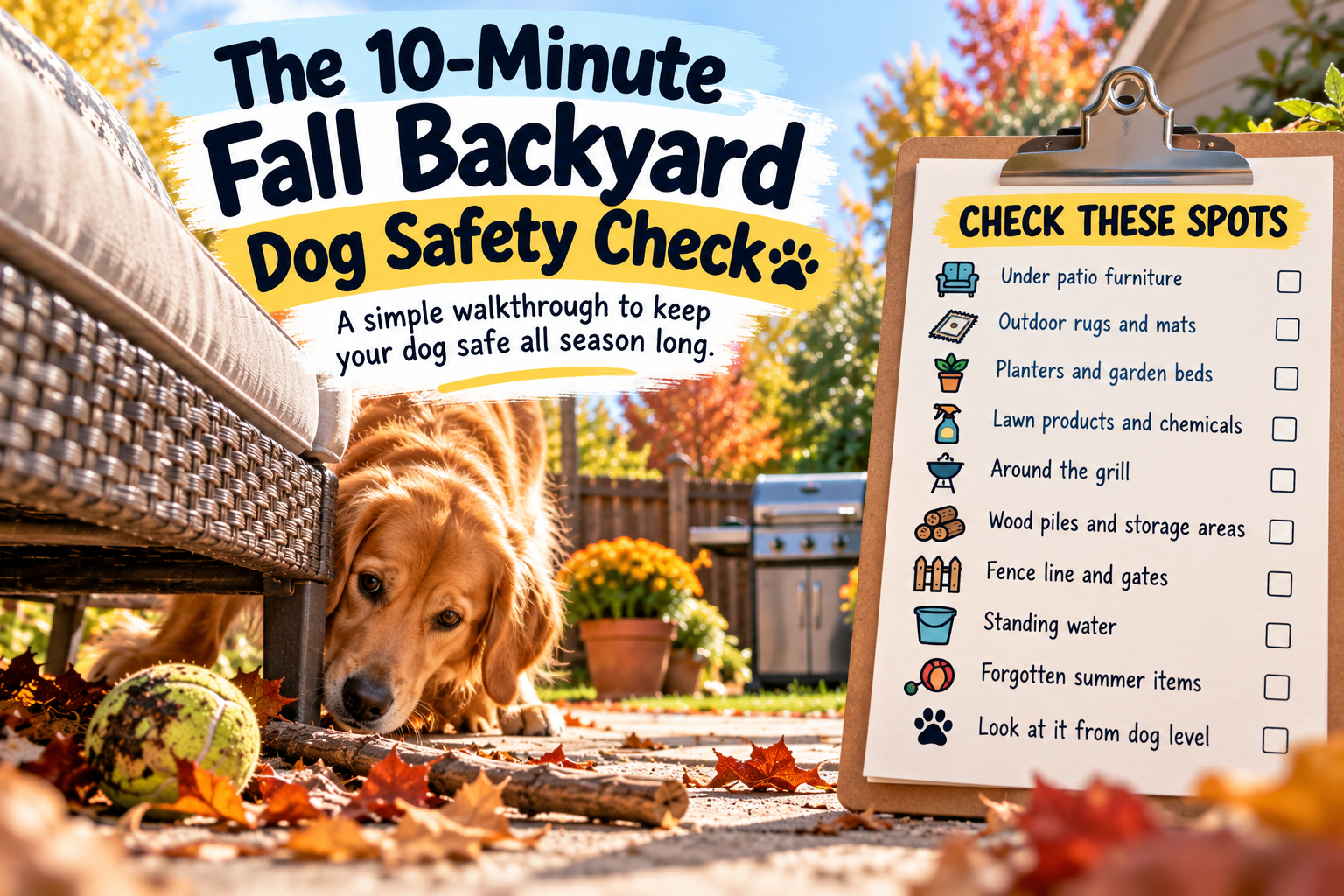
This is my favorite part of the entire check.
Seriously.
Crouch down.
Look around your backyard from the height of your dog’s head.
Things change.
You suddenly notice the gap beneath the shed.
The bag tucked behind the planter.
The cord hanging down.
The spilled seed.
The little object underneath the chair.
The opening beneath the fence.
The thing you’ve walked past 100 times because it’s below your normal line of sight.
You see a backyard.
Your dog sees several thousand things requiring immediate investigation.
And that brings us to the point of this whole exercise.
The Bark Clinic 10-Minute Backyard Checklist
Before you close the backyard for fall:
□ Move patio furniture and inspect underneath
□ Lift outdoor rugs and mats
□ Check around pots and planters
□ Remove wild mushrooms your dog could access
□ Secure fertilizer and lawn-care products
□ Inspect behind and underneath the grill
□ Check firewood and storage areas
□ Confirm rodent-control products are inaccessible
□ Walk the fence and check the gates
□ Dump unnecessary standing water
□ Pick up forgotten summer items
□ Do one final scan from dog height
Done.
You didn’t sterilize your backyard.
You didn’t bubble-wrap your dog.
You just made it harder for them to discover something unfortunate before you do.
What If My Dog Already Ate Something?
This is where we don’t improvise.
If you think your dog swallowed a wild mushroom, pesticide, fertilizer, rodenticide or another potentially toxic substance, contact your veterinarian or an animal poison-control service promptly rather than waiting for symptoms to appear.
Don’t induce vomiting or start trying home remedies unless a veterinarian or poison-control professional specifically tells you to. Whether vomiting is appropriate depends on what was swallowed and what else is going on.
If possible, keep the packaging or take a picture of the label.
If it’s a mushroom, take clear pictures of the mushroom and the area where it was growing if you can do so safely.
Those details may be much more useful than:
“He ate some weird brown thing from behind the chair.”
You can contact your veterinarian, an emergency veterinary hospital, ASPCA Animal Poison Control Center at 888-426-4435, or Pet Poison Helpline at 855-764-7661. Consultation fees may apply.
The Bark Clinic Bottom Line
Fall backyard cleanup usually means stacking chairs, putting away cushions and wondering how you somehow acquired nine outdoor pillows.
For dog owners, add one more job:
Look at the yard the way your dog does.
Under things.
Behind things.
Inside things.
And especially at anything that smells remotely edible despite having absolutely no business being eaten.
Ten minutes isn’t going to eliminate every backyard risk.
But it can uncover the forgotten bag, mystery mushroom, loose fence board or summer cookout souvenir before the furry member of your household conducts their own inspection.
And your dog’s inspection procedure is considerably less thorough.
It mostly involves putting the evidence directly into their mouth. 🐶🍂
This article is educational and is not a substitute for veterinary care. If your dog is unwell, contact your veterinarian.
Keep reading
Fall Walk Safety: What Dog Owners Should Watch For
Acorns, antifreeze, early darkness, and cooling temperatures — the season brings a fresh set of walk-time hazards. Here's your checklist.
Read article
My Dog Ate Something They Shouldn’t: What to Do in the First 10 Minutes
Did your dog eat something they shouldn’t? Here’s what to do in the first few minutes, what information to gather, what not to try at home, and when to seek emergency veterinary help.
Read article
The Ultimate Halloween Dog Safety Checklist: Before, During & After Trick-or-Treating
Halloween is full of fun—and a surprising number of dog hazards. Use this before-during-after checklist to keep the candy, costumes and chaos from becoming an emergency.
Read article