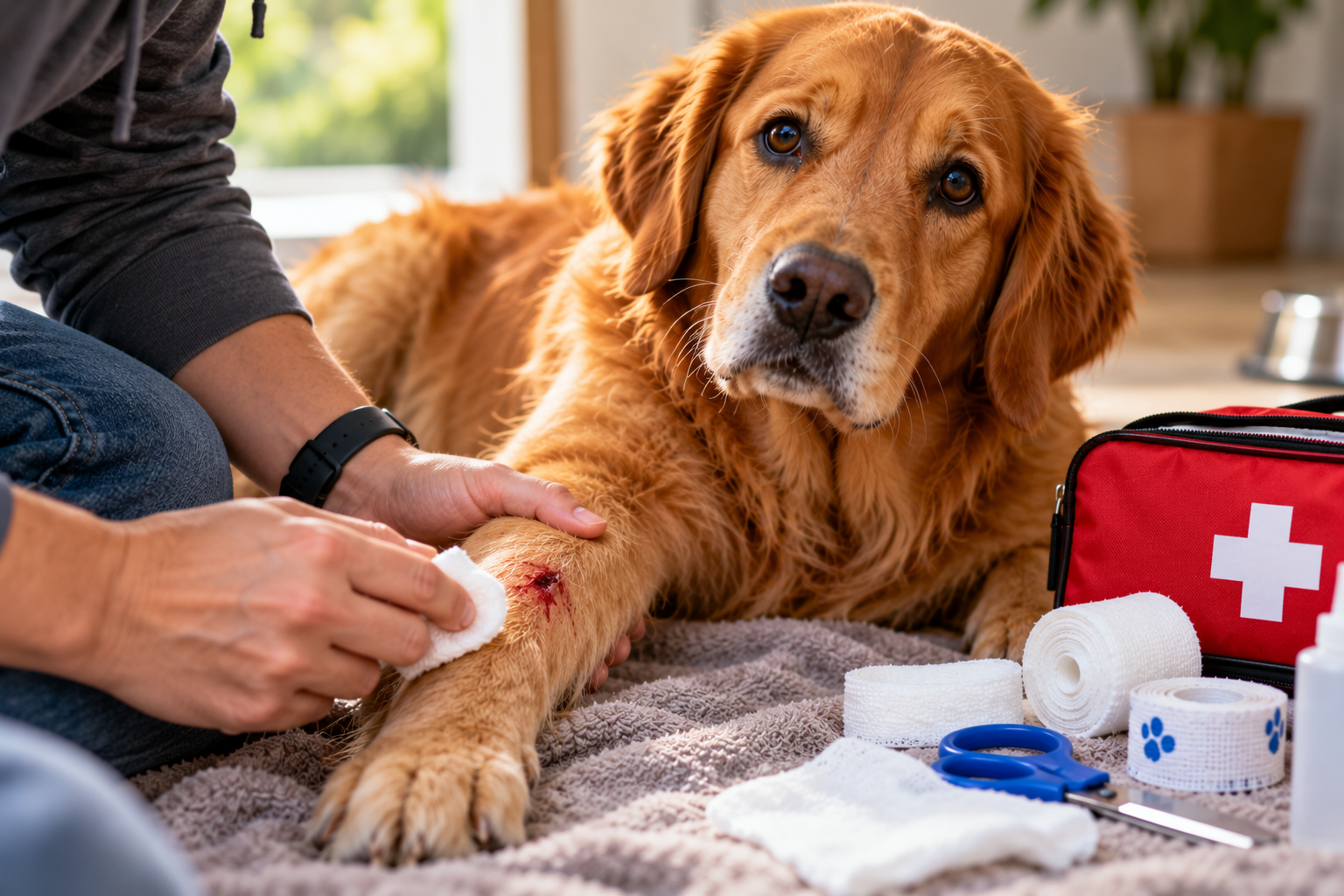
Dogs have a remarkable ability to injure themselves doing things they’ve done successfully 4,000 times.
One minute they’re running through the backyard like an Olympic athlete.
The next minute they’re standing in the kitchen with a cut on their leg, looking at you like you’re the one who needs to explain what happened.
And now there’s blood.
Your brain immediately starts cycling through the questions:
How bad is that?
Can I handle this at home?
Does my dog need stitches?
Why is there somehow blood on the couch already?
Cuts and scrapes are common, but deciding how serious one is can be difficult—especially because fur can hide the actual size of a wound.
So here’s what to do before panic-Googling your way into the darkest corners of the internet.
First: Forget the Stitches for a Second
When your dog gets cut, your first question shouldn’t actually be “Does this need stitches?”
It’s:
“Is my dog otherwise okay, and can I control the bleeding?”
Veterinary emergency guidance prioritizes the dog’s overall condition before the wound itself. Severe or uncontrolled bleeding, difficulty breathing, collapse, major trauma or other signs that your dog is seriously unwell require immediate veterinary attention.
A dramatic-looking cut can steal your attention while something more serious is happening.
So take a quick look at the whole dog, not just the blood.
Then deal with the wound.
If It’s Bleeding, Apply Pressure
This isn’t the moment to assemble a home operating room.
Grab clean gauze, a clean towel or another clean absorbent cloth and apply firm, direct pressure to the wound. Direct pressure is one of the basic first steps veterinarians recommend for controlling external bleeding.
And here’s an important part:
Don’t keep lifting the towel every eight seconds to see whether it worked.
We know. You want to look.
Resist.
If blood soaks through the material, veterinary emergency guidance recommends adding more material on top rather than pulling the original layer away, which can disturb clot formation.
If bleeding is heavy, spurting, rapidly pooling, soaking through dressings quickly or simply won’t come under control, you’re past the “let’s watch this at home” stage. Seek urgent veterinary care.
Okay. So Does My Dog Actually Need Stitches?
Here’s the annoying answer:
You can’t always tell just by looking at it.
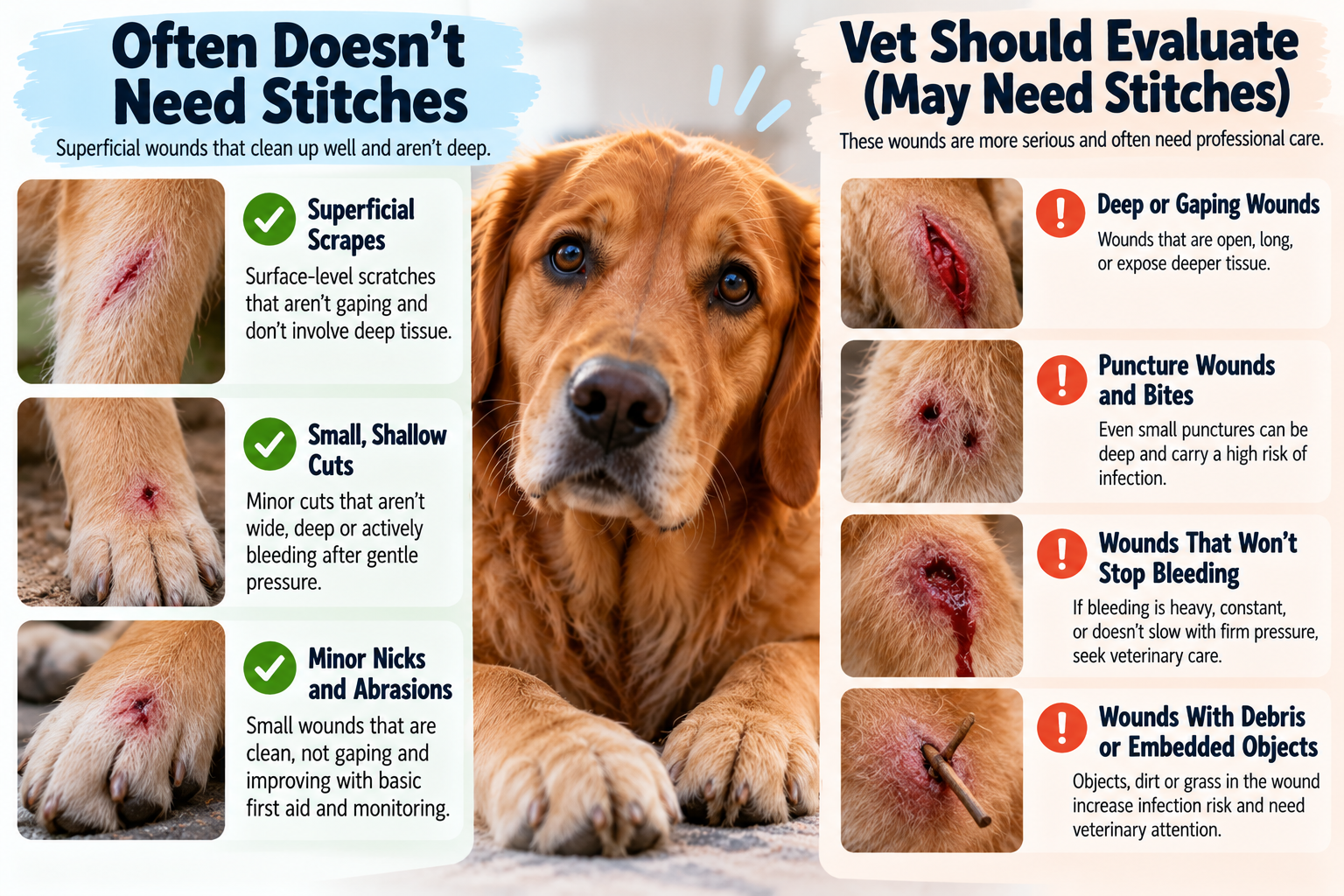
A veterinarian decides whether a wound should be closed after considering things such as its depth, contamination, location and damage beneath the skin. Some wounds can be closed with sutures, staples or surgical adhesive. Others are intentionally left open because closing a contaminated or infected wound can be the wrong approach.
That’s why the internet rule of:
“If it’s longer than ___, it needs stitches”
isn’t particularly useful.
A small puncture can potentially cause more trouble than a longer superficial scrape.
And bite wounds deserve particular respect. What looks like a tiny puncture on the surface can hide considerably more tissue damage underneath.
Signs I’d Want a Vet to Evaluate
Have a veterinarian assess the wound promptly if it’s deep or gaping, won’t stop bleeding, contains embedded debris, came from an animal bite, involves significant trauma, exposes deeper tissue, or is located around a particularly sensitive area such as the eye.
I’d also err toward veterinary evaluation when you’re simply not sure how deep it goes.
That’s not overreacting.
That’s what vets are for.
“It’s Tiny, Though.”
This is where dogs fool us.
You part the fur and find what looks like a little hole.
Oh. That’s nothing.
Not necessarily.
Puncture wounds—particularly bites—can introduce bacteria beneath the skin while leaving relatively little damage visible on the surface. Merck notes that bite wounds can range from punctures to deep gashes and that cat bites in particular can be small punctures that readily become infected.
So don’t judge an injury exclusively by how impressive it looks.
Sometimes the boring-looking wound is the one that deserves attention.
What Can I Safely Clean It With?
For a minor wound you’re managing while contacting or following instructions from your veterinarian, clean water or saline are much safer default choices than reaching into the bathroom cabinet and conducting chemistry experiments.
VCA specifically advises using water or saline for wound cleaning and warns against products such as rubbing alcohol, hydrogen peroxide, soaps, shampoos, tea tree oil and other preparations unless your veterinarian directs you to use them, because some can damage tissue or delay healing.
So let’s retire the idea that:
“If it burns like hell, that means it’s working.”
Your dog would appreciate it.
Also avoid randomly slathering creams, ointments or disinfectants onto an open wound unless your veterinarian has told you to use them.
Don’t Become a Backyard Surgeon
There’s a point where helping becomes doing too much.
If something is deeply embedded in the wound, don’t start digging around with tweezers because you’ve watched three seasons of a medical drama.
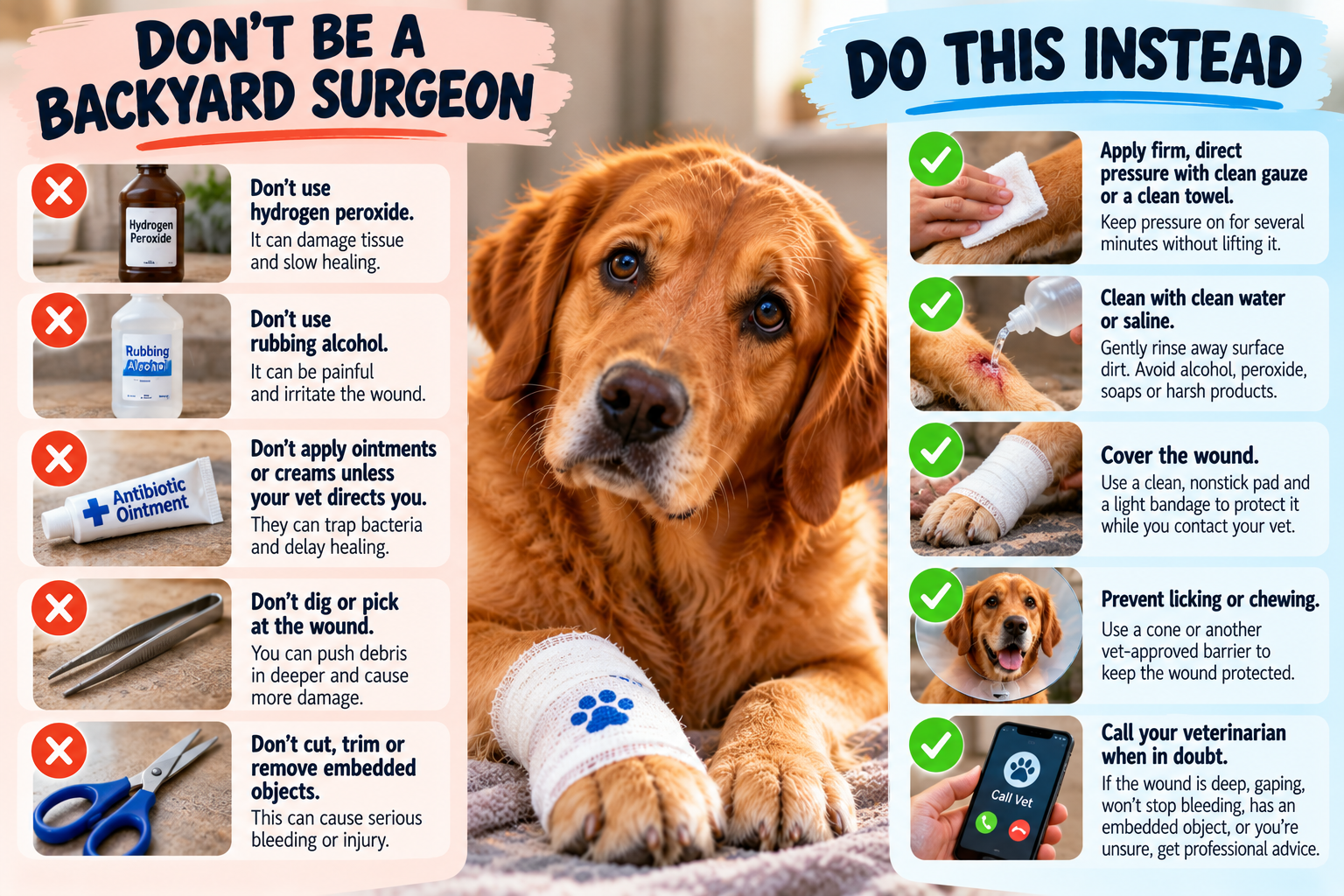
And if a stick or another object has actually penetrated your dog’s body, don’t pull it out. Veterinary emergency guidance recommends stabilizing penetrating foreign objects for transport rather than removing them, because removal can cause additional damage or bleeding.
Cover the area as appropriately as you can, keep your dog calm and call the vet.
This is their department now.
And Yes, Your Dog Is Going to Try to Lick It
Of course they are.
You just spent ten minutes carefully cleaning and protecting the wound.
Your dog has reviewed your work.
They have notes.
Dogs can traumatize wounds further by licking or chewing them, which is why veterinary wound management often includes preventing access with an Elizabethan collar or another veterinarian-approved barrier.
The cone may result in a facial expression suggesting that you’ve committed the greatest betrayal in the history of human-canine relations.
Stay strong.
Watch the Wound Afterward
Even a wound that initially seemed manageable deserves another look as it heals.
Watch for increasing redness, swelling, discharge, worsening pain, reopening or other changes that concern you. Veterinary aftercare guidance specifically recommends monitoring treated wounds and stitches for redness, swelling and discharge.
And pay attention to the dog attached to the wound.
A dog who becomes unusually lethargic, painful or otherwise seems unwell deserves more attention than the wound alone might suggest.
Knowing your dog’s normal behavior matters here.
Your Five-Minute “Oh Crap, My Dog Is Bleeding” Plan
When something happens, remember this sequence:
Check your dog → Control the bleeding → Look at the wound → Protect it → Call the vet when you’re unsure.
You don’t need to diagnose exactly which layers of tissue are involved.
You don’t need to determine which suture pattern would look best.
And you definitely don’t need to Google “Can I superglue my dog’s cut?”
Please don’t make us write that article next.
Your job is first aid.
Your veterinarian’s job is everything that comes after.
The Bark Clinic Bottom Line
Some minor scrapes really are minor.
But the amount of blood isn’t the only thing that determines how serious a wound is. Depth, location, contamination, cause and damage beneath the surface all matter, and those aren’t always easy to judge at home.
If your dog’s wound is bleeding heavily, won’t stop with direct pressure, is deep or gaping, resulted from a bite or significant trauma, contains an embedded object, or your dog seems seriously unwell, get veterinary help promptly.
For everything else, when you’re standing in the kitchen holding a towel against your dog’s leg wondering whether you’re being ridiculous for calling the vet:
Call.
Worst-case scenario, you asked a professional about a wound that turns out to be minor.
That’s a considerably better problem than discovering the little cut under all that fur wasn’t so little after all.
And once everybody is okay, you may begin the secondary investigation:
What the hell did you cut yourself on?
Your dog will be declining to comment. 🐶
This article is educational and is not a substitute for veterinary care. If your dog is unwell, contact your veterinarian.
Keep reading
Dog First Aid Kit: What You Actually Need (and What You Don’t)
What actually belongs in a dog first aid kit? Here’s our practical checklist of useful supplies, what to skip, and how to prepare before your dog has an emergency.
Read article
The 10-Minute Fall Backyard Dog Safety Check
Closing up the backyard for fall? Take 10 minutes to walk through it from your dog’s point of view and catch the things hiding under furniture, behind planters and around the yard before your dog does
Read article
My Dog Ate Something They Shouldn’t: What to Do in the First 10 Minutes
Did your dog eat something they shouldn’t? Here’s what to do in the first few minutes, what information to gather, what not to try at home, and when to seek emergency veterinary help.
Read article