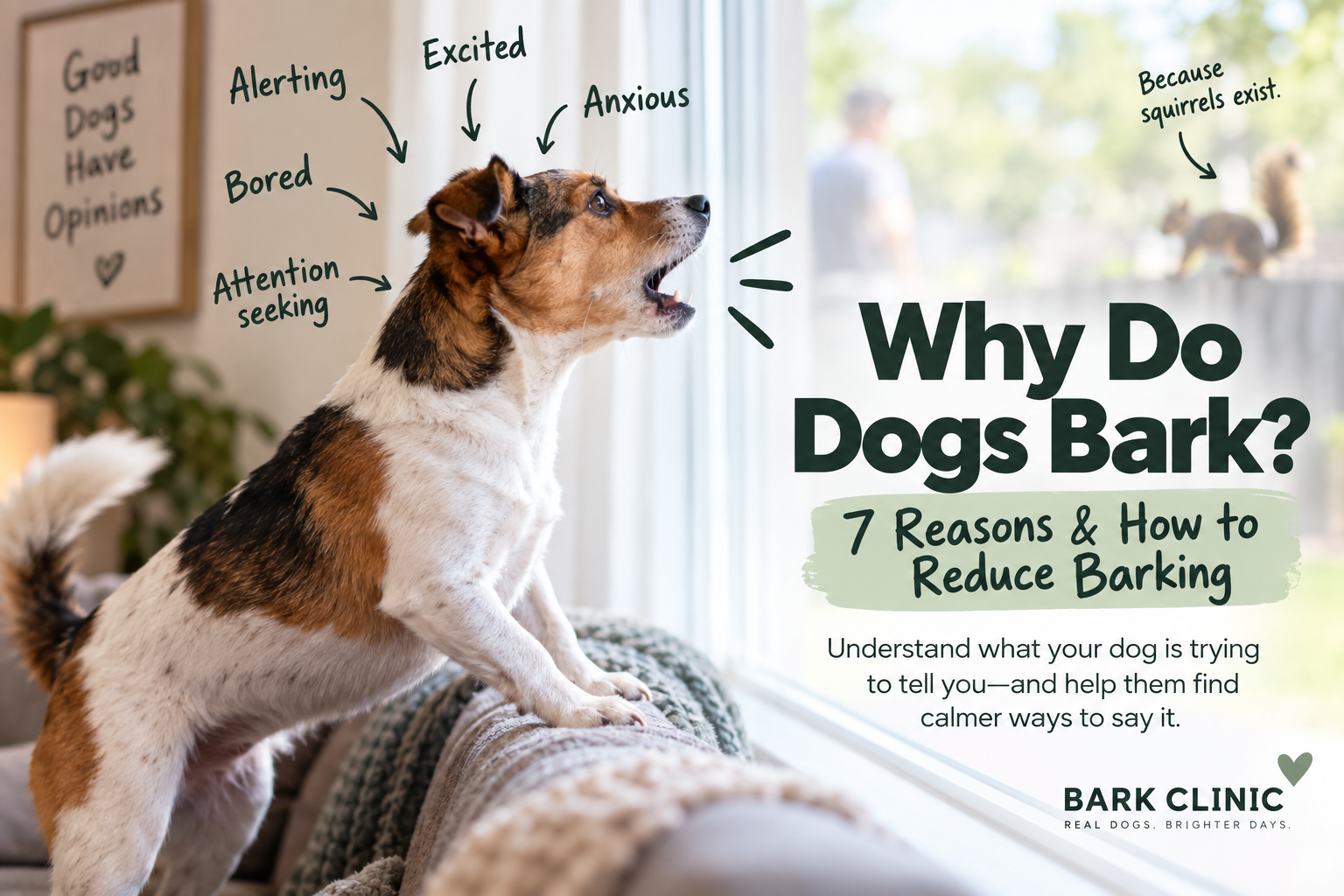
Barking is not a character flaw. It’s communication with volume.
Dogs bark because something is happening. Maybe a stranger is approaching the house. Maybe they’re scared, excited, frustrated, bored, or desperate to get your attention. Or maybe, they see the exact same garbage cans out of the living room window every Tuesday morning, right Teddy?
Whatever the reason, barking is one of the ways dogs communicate with us and the world around them. And if you’re wondering why your dog barks so much, the answer usually isn’t that you have a “bad dog.”
The key to reducing excessive barking is figuring out why your dog is barking in the first place.
Why Do Dogs Bark?
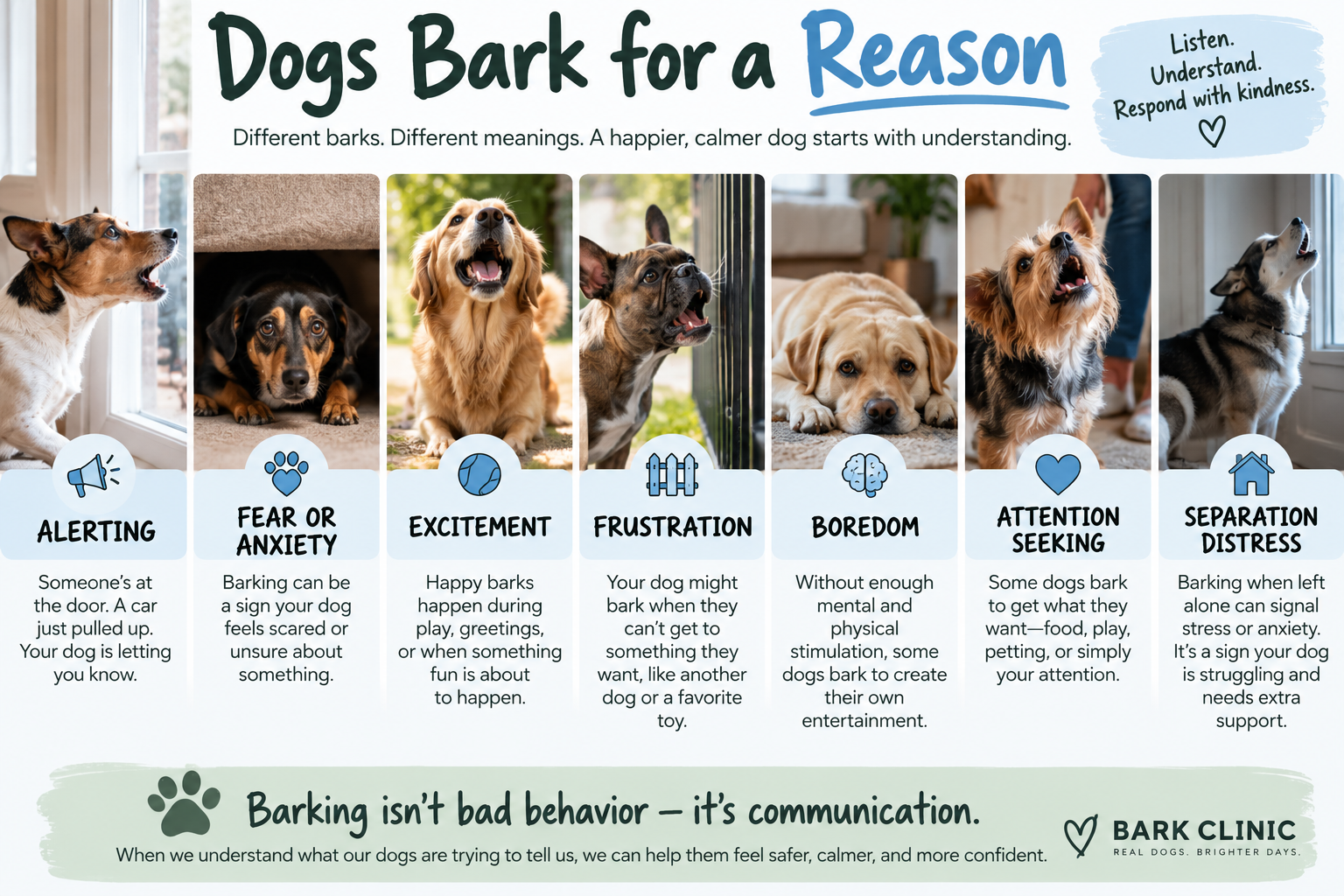
Dogs can bark for many different reasons, including:
Alerting you to people, animals, or unusual sounds
Fear or anxiety
Excitement
Frustration
Boredom or lack of stimulation
Attention seeking
Play
Territorial behavior
Separation-related distress
Trying to gain access to something they want
That’s why there isn’t one universal trick to stop a dog from barking.
A dog barking because they’re bored needs something very different from a dog barking because they’re frightened.
Before trying to stop the noise, figure out what your dog is trying to say.
Find Your Dog’s Barking Trigger
Start by noticing what happens immediately before your dog begins barking.
Does the doorbell ring?
Does someone walk past the window?
Does another dog appear?
Does barking begin when you leave the house?
Does your dog start barking when you pick up the leash?
The trigger gives you your first clue.
Next, look at your dog’s body language.
A loose, wiggly dog barking during play is telling a very different story from a stiff dog barking while leaning backward or trying to create distance.
If the pattern isn’t obvious, keep a simple barking log for several days. Write down:
Trigger → Time → Duration → What stopped the barking
You may quickly discover patterns that are hard to notice in the moment.
And that information is usually much more useful than yelling “QUIET!” for the fiftieth time.
Stop Your Dog From Practicing the Barking Behavior
One of the most overlooked ways to reduce excessive dog barking is simply preventing your dog from rehearsing it all day.
Imagine your dog spends twenty minutes every afternoon launching a full-scale security operation against everyone walking past the front window.
Every afternoon, they get another twenty minutes of practice.
Instead, change the environment while you're working on the underlying behavior.
You might:
Close the blinds or curtains
Add privacy film to frequently watched windows
Move furniture away from windows
Use white noise to reduce outside sounds
Create more distance between your dog and a trigger
Redirect your dog before barking escalates
This is called management, and management isn't cheating.
It prevents your dog from repeatedly practicing a behavior you're trying to change.
Could Your Dog Be Barking Because They’re Bored?
Sometimes barking isn't about fear or guarding anything.
Your dog simply needs something to do.
Dogs need opportunities to use their brains and bodies. When those needs aren't being met, some dogs create their own entertainment.
Unfortunately, their chosen hobby might be screaming at delivery trucks.
Try adding more dog enrichment activities throughout the day, such as sniff walks, food puzzles, safe chew toys, training games, hide-and-seek, scatter feeding, or a snuffle mat.
Mental enrichment can be just as valuable as physical exercise.
A dog with an appropriate job is often much less interested in inventing one.
Teach Your Dog What to Do Instead of Barking
Instead of focusing exclusively on stopping barking, teach your dog the behavior you'd rather see.
Start by rewarding calm moments.
If your dog notices something outside without barking, that's an opportunity.
Reward it.
If a known trigger appears at a distance your dog can comfortably handle, pair that trigger with something your dog loves, such as a favorite treat.
Over time, you're helping change the prediction:
Trigger appears → good things happen → I can stay calm and check in with my person.
You're not rewarding your dog for being afraid.
You're helping your dog develop a different emotional response to something that previously caused fear, frustration, or overexcitement.
Avoid Punishing Your Dog for Barking
Punishment may stop the sound temporarily without addressing the reason behind it.
If your dog is barking because they're frightened, adding pain, fear, or intimidation doesn't make the frightening thing less scary.
It can do the opposite.
Instead of relying on punishment-based barking tools, focus on identifying triggers, managing your dog's environment, rewarding calm behavior, and gradually teaching your dog a better response.
The goal isn't simply a quieter dog.
It's a dog who feels comfortable enough that barking isn't always necessary.
Why Does My Dog Bark When I Leave?
Barking when left alone deserves special attention.
Some dogs bark briefly when their person leaves and then settle down. Others experience significant distress.
Watch for barking accompanied by behaviors such as:
Destructive behavior
Attempts to escape
Excessive drooling
Persistent pacing
Inability to settle
Panic around departures
These behaviors can be associated with separation-related distress.
If your dog appears panicked when left alone, talk with your veterinarian or a qualified canine behavior professional. Severe separation problems usually require more than simply giving your dog something to occupy their time.
When Should You Talk to Your Veterinarian About Barking?
A sudden change in barking behavior deserves attention, particularly in older dogs.
Pain, changes in hearing or vision, cognitive changes, and other medical problems can sometimes affect a dog's behavior.
Contact your veterinarian if your dog suddenly begins barking significantly more than usual, seems confused or distressed, develops other behavioral changes, or shows signs of discomfort.
Behavior and health are closely connected, so unexplained changes shouldn't automatically be dismissed as a training problem.
This article is educational and is not a substitute for veterinary care. If your dog is unwell, contact your veterinarian.