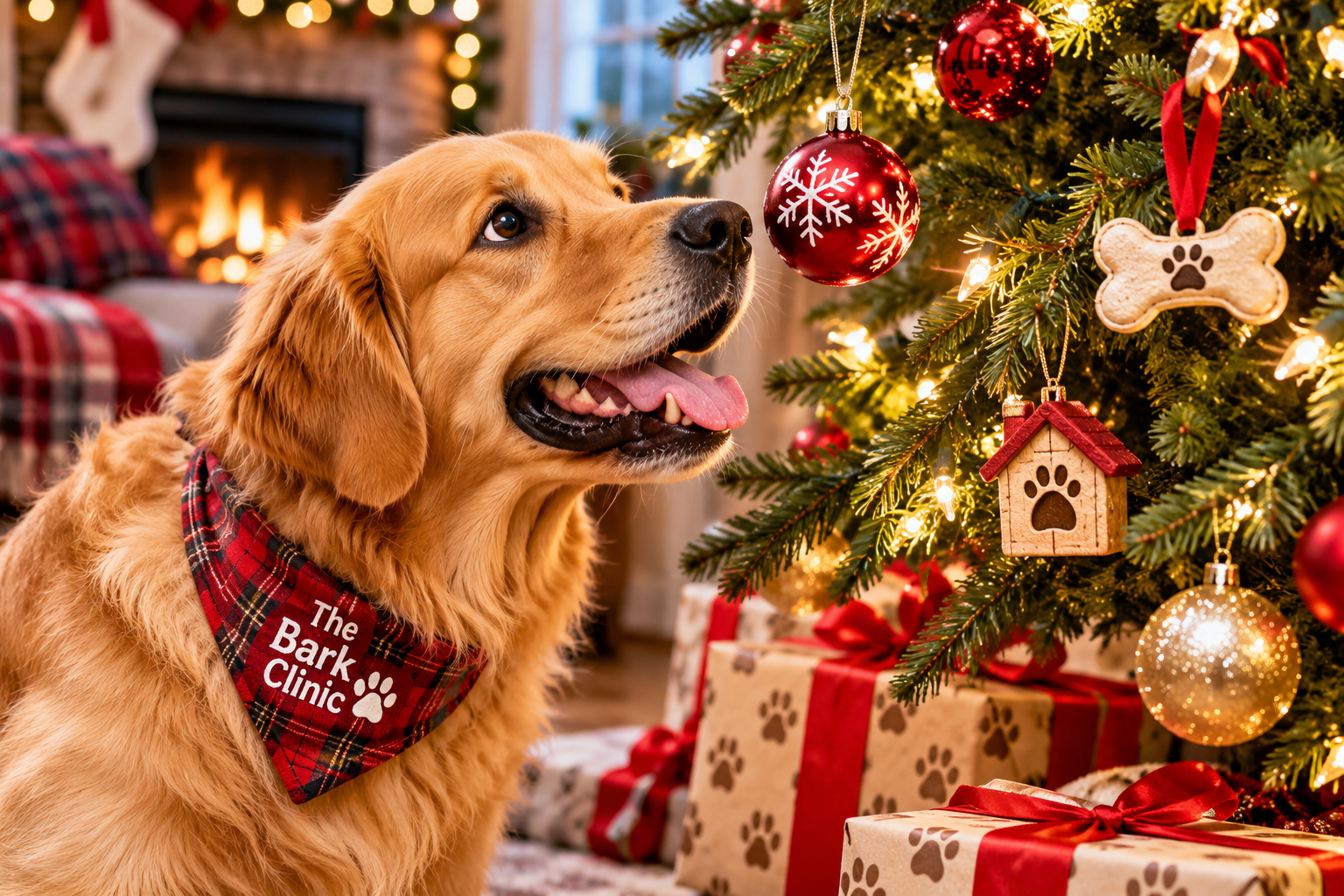
You spent three hours decorating the Christmas tree.
You carefully arranged the ornaments, untangled approximately 47 miles of Christmas lights, and positioned the star at precisely the right angle.
You stepped back to admire your masterpiece.
Your dog stepped forward to inspect the new indoor playground.
And just like that, Christmas became a contact sport.
From your dog's perspective, you've dragged an entire tree into the living room, covered it with dangling objects, wrapped it in blinking lights, and placed mysterious boxes underneath.
Then, for some completely unreasonable reason, you expect them not to touch anything.
Honestly, the rules are getting confusing.
But while your dog's fascination with the Christmas tree can be hilarious, holiday decorations introduce some genuine safety hazards.
Here's how to dog-proof your Christmas tree without sacrificing the holiday magic—or spending Christmas Eve at the emergency veterinarian.
Why Are Dogs So Interested in Christmas Trees?
Imagine waking up one morning and discovering somebody installed a giant, glowing snack-and-toy dispenser in your living room.
That's roughly how Christmas might feel to a curious dog.
Christmas trees introduce several things dogs naturally want to investigate:
Unfamiliar smells: Real trees bring outdoor scents into an indoor environment.
Dangling decorations: Ornaments sway and move, making them tempting targets for playful paws.
Bright lights: Flashing and twinkling decorations may attract attention.
New objects: Wrapped presents, ribbons, and tree skirts invite investigation.
Changes in routine: Rearranged furniture and holiday visitors can make some dogs more excited or unsettled.
Your dog isn't necessarily trying to ruin Christmas.
They're exploring an unfamiliar addition to their environment.
Unfortunately, curiosity doesn't come with an understanding of electrical safety or a healthy respect for glass ornaments.
That's where you come in.
1. Secure Your Christmas Tree Like It's Preparing for Battle
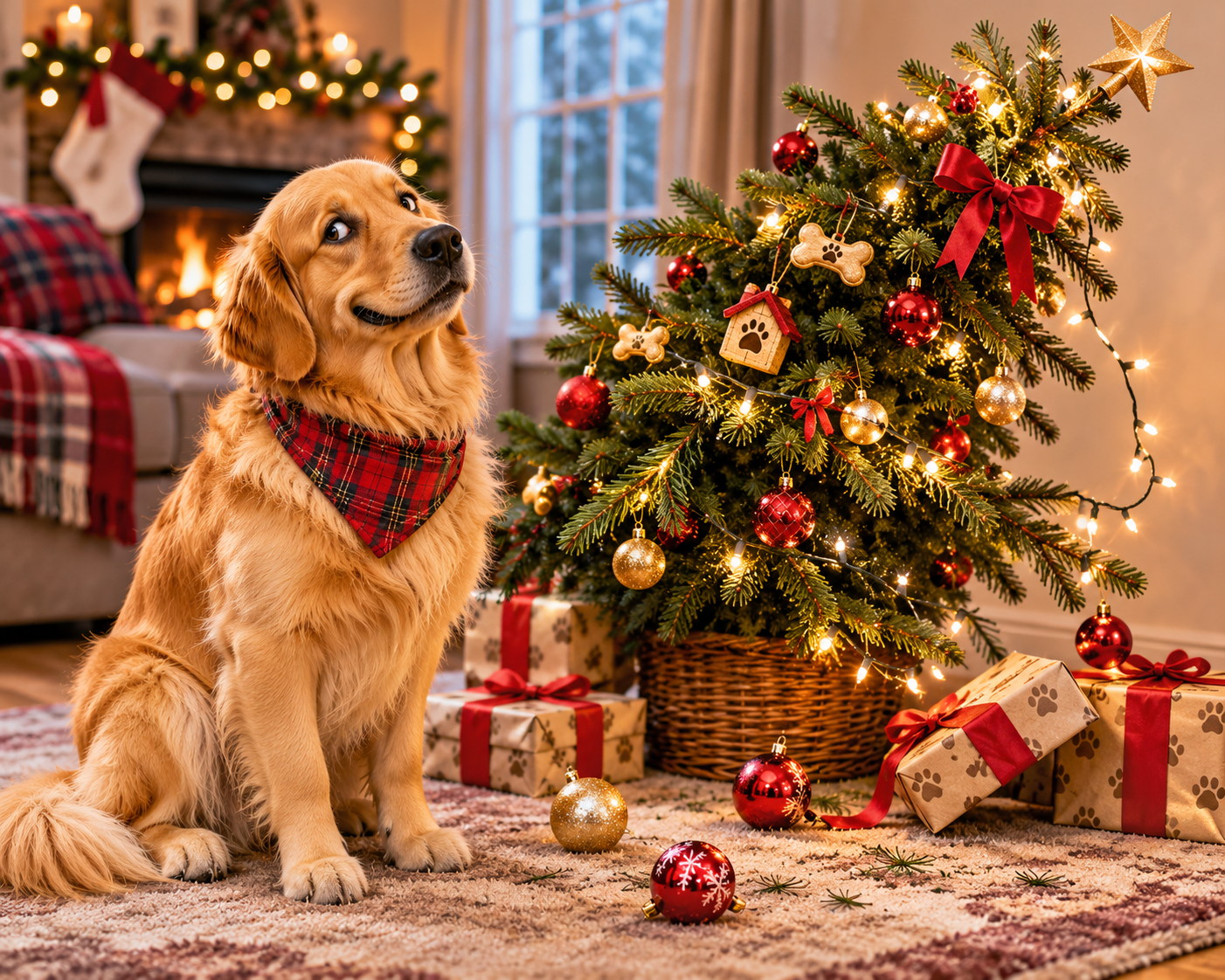
Your Christmas tree looks sturdy.
Your 75-pound Labrador disagrees.
One enthusiastic tail wag, a poorly executed zoomie, or an ambitious attempt to investigate the branches can send the entire tree crashing down.
And nothing destroys holiday cheer quite like hearing the words, "THE TREE IS FALLING!"
How to prevent it:
Choose a sturdy tree stand appropriate for the tree's size.
Place the tree away from narrow walkways and favorite dog play areas.
Secure it to a wall or other suitable structural anchor using appropriate hardware.
Consider a pet gate if your dog enjoys jumping, climbing, or wrestling with stationary objects.
The Bark Clinic verdict: If your Christmas tree can't survive one Labrador turning around, it's not ready for the holidays.
2. Keep Fragile Ornaments Above Tail-Wagging Altitude
Dogs have an impressive talent for finding the one expensive ornament you inherited from your grandmother.
It's almost supernatural.
You can hang 60 inexpensive decorations, but somehow your dog will investigate the irreplaceable glass angel from 1987.
Glass ornaments can shatter, causing injuries to paws and mouths. Small decorations and hooks can also present choking or gastrointestinal hazards if swallowed.
Try these safer decorating habits:
Place fragile ornaments on higher branches.
Use sturdy, shatter-resistant decorations where your dog can reach.
Secure ornaments firmly rather than relying on loose hooks.
Avoid small ornaments that could be swallowed.
Skip edible ornaments, including popcorn garlands and candy decorations.
Remember that shatter-resistant doesn't mean chew-proof. Even plastic ornaments can break into dangerous pieces.
Holiday survival tip: The bottom third of your tree does not need to resemble a jewelry store.
Your dog will survive the disappointment.
3. Christmas Tree Water Is Not a Doggy Drinking Fountain
You've provided your dog with a clean bowl of fresh water.
But apparently, the mysterious liquid beneath the Christmas tree has a more sophisticated flavor profile.
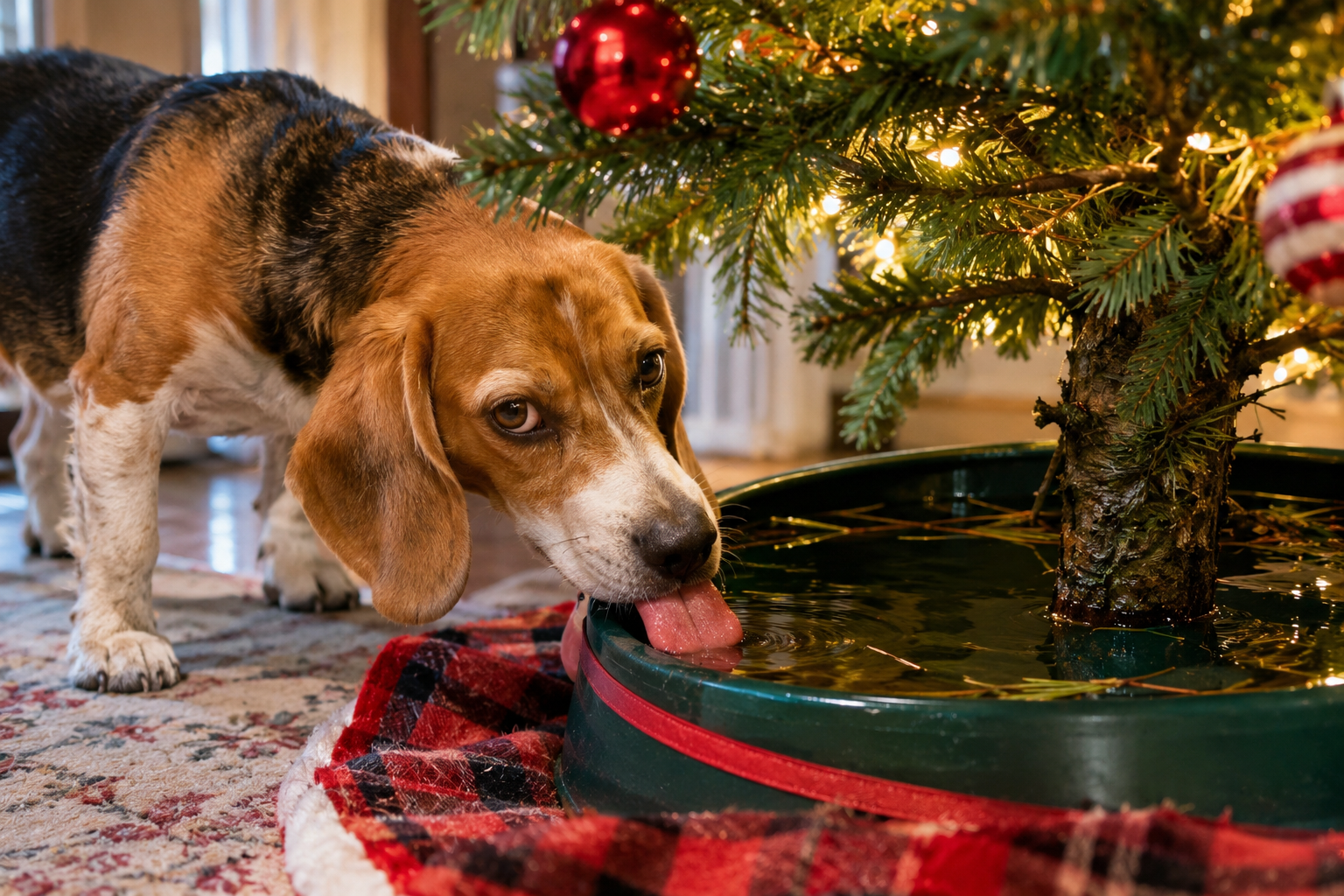
Why drink ordinary water when there's Forbidden Forest Soup™ available?
Unfortunately, Christmas tree stand water isn't a safe drinking source.
It can accumulate bacteria and may contain fertilizers, preservatives, or other chemicals. Drinking contaminated water can cause vomiting, diarrhea, or other health problems.
What to do:
Cover the tree stand with a secure barrier that prevents access to the water.
Use plain water rather than adding homemade additives or tree preservatives.
Check frequently to make sure your dog can't move the cover.
Keep your dog's normal water bowl clean and accessible.
A decorative tree skirt alone may not keep a determined dog away from the stand.
The Bark Clinic verdict: Christmas tree water belongs to the tree. Your dog does not need a subscription.
4. Keep Electrical Cords Away From Curious Teeth
Christmas lights are beautiful.
Electrical cords? Not so much, especially when your dog decides to investigate them with their mouth.
Chewing a plugged-in cord can cause serious electrical burns, shock, and potentially life-threatening injuries.
Puppies and dogs who chew household objects deserve extra supervision.
Protect your dog by:
Routing cords behind furniture or protective barriers.
Using properly installed cord protectors.
Keeping electrical connections inaccessible.
Inspecting cords regularly for damage.
Unplugging lights when the tree is unattended.
Battery-powered decorations also require caution. Batteries can cause serious injuries if swallowed or chewed.
And remember: low-voltage lights aren't automatically chew-safe.
Holiday survival tip: Your dog may have an advanced degree in chewing, but they're not a licensed electrician.
5. Skip the Tinsel Unless You Enjoy Emergency Vet Bills
Tinsel is shiny, festive, and beautiful.
It is also an impressively terrible thing for a dog to swallow.
Long strands can create dangerous intestinal problems, while other decorative ribbons and strings can become choking or obstruction hazards.
For that reason, the simplest option is to skip tinsel entirely in a home with pets.
Choose safer decorating alternatives that are securely attached and cannot be chewed or swallowed.
If your dog swallows tinsel, ribbon, or string, contact your veterinarian promptly, even if your dog initially seems fine.
Important: If string is protruding from your dog's mouth or rectum, do not pull it. Seek veterinary guidance immediately.
The Bark Clinic verdict: Sparkly intestinal surgery is not a Christmas tradition anyone needs.
6. Clean Up Fallen Pine Needles Before Your Dog Finds Them
Real Christmas trees smell wonderful.
But they also shed needles.
Some dogs ignore them completely. Others apparently believe every fallen object is a complimentary snack.
Swallowed pine needles can irritate a dog's mouth and digestive tract. Larger amounts may contribute to more serious gastrointestinal injuries or obstruction.
For a safer holiday:
Sweep or vacuum around the tree regularly.
Keep the tree properly watered to reduce excessive needle shedding.
Remove loose branches and damaged decorations.
Monitor dogs who tend to eat unfamiliar objects.
Artificial trees aren't hazard-free, either. Broken plastic needles, wires, and detachable components shouldn't be left within your dog's reach.
Holiday survival tip: If your dog treats the living room floor like an all-you-can-eat buffet, daily cleanup is essential.
7. Don't Put Edible Gifts Under the Tree
Your aunt wrapped a beautiful box of homemade chocolates.
Your dog located it in approximately four seconds.
You have no idea how.
Your dog has never successfully found a tennis ball in plain sight, yet somehow possesses military-grade technology for detecting food through wrapping paper.
Unfortunately, gifts containing chocolate, raisins, xylitol-containing products, or other dangerous ingredients can create serious emergencies.
A better approach:
Keep edible presents in cabinets or other inaccessible storage.
Avoid leaving food-filled stockings within reach.
Store wrapped gifts containing medication or cosmetics securely.
Supervise your dog during gift exchanges.
Clean up bows, ribbon, wrapping paper, and small toy components promptly.
Your dog doesn't understand that the chocolate-covered pretzels are for Uncle Dave.
And frankly, Uncle Dave probably shouldn't leave them on the floor.
8. Give Your Dog an Actual Toy to Enjoy
Here's a revolutionary Christmas idea:
Instead of expecting your dog to ignore every exciting object in the living room, provide something they're allowed to investigate.
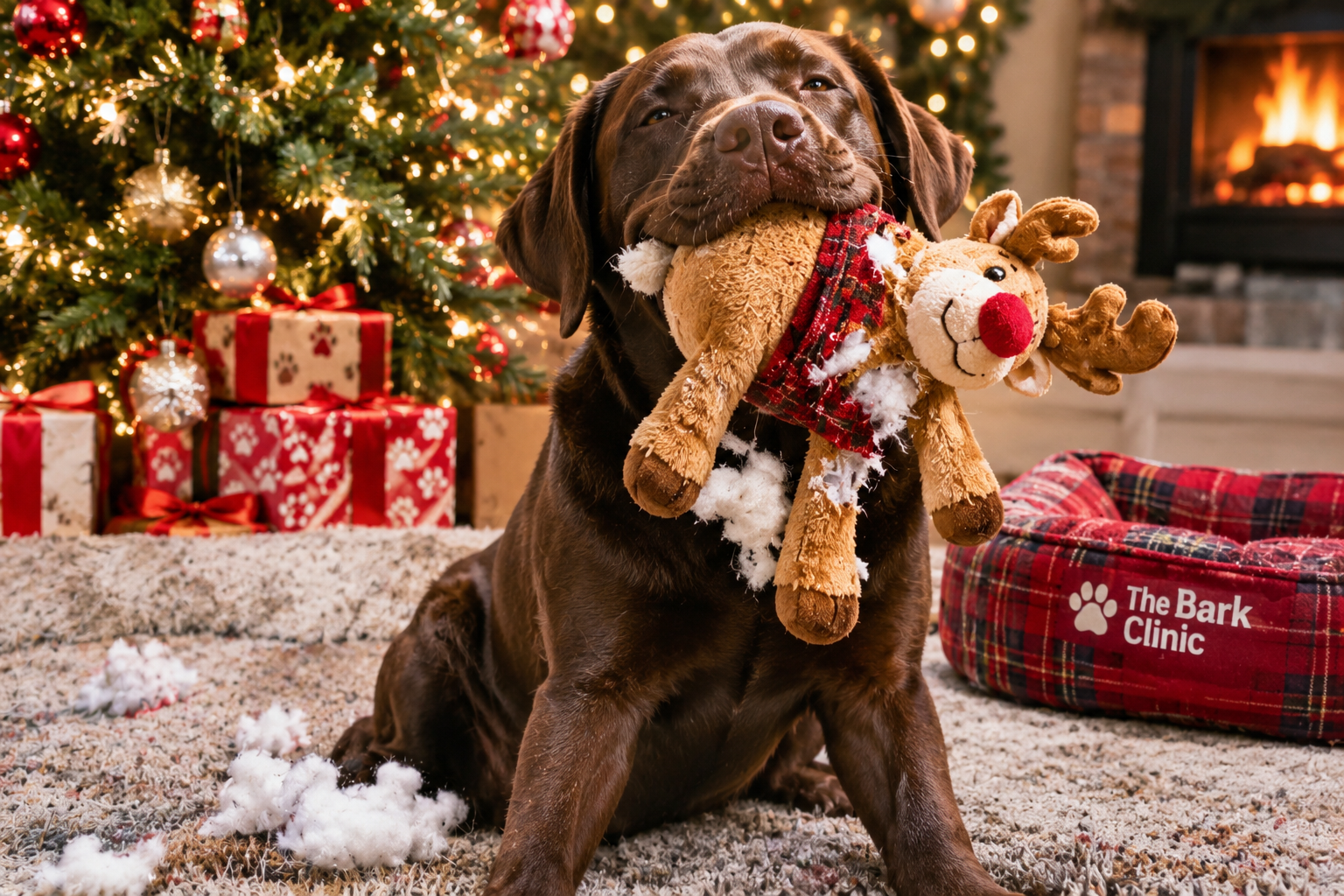
Dogs need appropriate outlets for chewing, sniffing, and play.
Try:
A durable, size-appropriate chew toy
A supervised food puzzle
A stuffed enrichment toy suitable for your dog
A snuffle mat with part of their regular meal
A short training session away from the decorations
You can also reward your dog for choosing their own toy or settling calmly near the tree.
And if your dog keeps returning to the ornaments, redirect them before they start rehearsing their one-dog demolition show.
The Bark Clinic verdict: Give the dog a legal hobby before they develop a criminal one.
9. Teach Your Dog That the Christmas Tree Is Off-Limits
You don't necessarily need to banish your dog from the living room until January.
Instead, teach them what to do around the tree.
Start by practicing familiar cues such as "leave it," "come," and "go to your mat" away from the decorations.
Gradually introduce the tree at a distance where your dog can remain calm.
Reward them for looking away from decorations, returning to you, or relaxing in their designated spot.
If your dog becomes overly interested, increase the distance and make the exercise easier.
Never punish your dog for showing curiosity. Supervision, management, and rewarding appropriate behavior are more effective than waiting for something to go wrong.
For persistent chewing, destructive behavior, or anxiety, consider working with a qualified reward-based trainer.
Holiday survival tip: You're teaching your dog that the Christmas tree is background scenery, not an invitation to wrestle.
10. When You Can't Supervise, Create a Dog-Free Christmas Tree Zone
Even a well-trained dog can make questionable decisions.
Especially when nobody's watching.
The safest approach for particularly curious puppies, destructive chewers, or dogs with a history of swallowing objects may be to separate them from the tree whenever they cannot be supervised.
Consider:
A sturdy pet gate
A separate room
A properly introduced playpen
A comfortable, dog-safe resting area
If your dog is already comfortable with crate training, their crate may provide another safe resting option.
Don't use confinement as punishment. Make sure they have appropriate space, water, comfort, and opportunities for exercise and bathroom breaks.
The Bark Clinic verdict: Sometimes protecting Christmas means temporarily revoking your dog's decorating privileges.
What If Your Dog Eats a Christmas Decoration?
Despite your best efforts, accidents happen.
If you suspect your dog has swallowed an ornament, tinsel, ribbon, pine needles, a battery, or another potentially dangerous object, contact your veterinarian or an emergency veterinary hospital for guidance.
Seek emergency veterinary care immediately for choking, breathing difficulties, collapse, seizures, or signs of serious electrical injury.
Other warning signs may include:
Repeated vomiting or retching
Abdominal pain or swelling
Excessive drooling
Refusing food
Unusual lethargy
Straining to defecate
Blood in vomit or stool
Some swallowed objects can cause problems before obvious symptoms appear.
Don't induce vomiting or try home remedies unless a veterinarian or animal poison specialist specifically instructs you to do so.
For possible poisoning, you can also contact the ASPCA Animal Poison Control Center at (888) 426-4435 or Pet Poison Helpline at (855) 764-7661. Consultation fees may apply.
Your 5-Minute Dog-Proof Christmas Tree Checklist
Before declaring your holiday decorating mission complete, run through this quick safety check.
Christmas tree is stable and securely anchored.
Fragile ornaments are out of reach.
Tinsel and swallowable decorative strings have been removed.
Electrical cords and batteries are inaccessible.
Tree stand water is securely covered.
Fallen needles and ornament pieces have been cleaned up.
Edible gifts are stored away from the tree.
Your dog has appropriate toys and activities.
A gate or separate space is available when supervision isn't possible.
Congratulations.
Your Christmas tree has officially passed its first canine safety inspection.
Unfortunately, the inspector would still like to eat the star.
Frequently Asked Questions About Dogs and Christmas Trees
Are real Christmas trees safe for dogs?
Real Christmas trees can be part of a dog-friendly home when appropriate precautions are taken. However, fallen needles, accessible tree water, decorations, and electrical cords create potential hazards. Secure the tree, block access to the water, and clean up needles regularly.
Are artificial Christmas trees safer for dogs?
Artificial trees avoid some issues associated with real tree water and natural needle shedding, but they still present hazards. Dogs may chew plastic branches, wires, ornaments, or other decorative components. Neither option is automatically dog-proof.
Why does my dog keep stealing Christmas ornaments?
Ornaments may resemble toys because they dangle, move, sparkle, or have unfamiliar textures. Dogs also naturally investigate new objects. Keep decorations out of reach and redirect your dog toward appropriate toys.
How do I keep my puppy away from the Christmas tree?
Use a combination of supervision, gates, appropriate chew toys, reward-based training, and a safe puppy area when you can't supervise. Puppies explore with their mouths, so keeping hazardous decorations inaccessible is particularly important.
Can dogs get sick from drinking Christmas tree water?
Yes. Christmas tree water can contain bacteria and potentially harmful additives or contaminants. Keep the stand covered and contact your veterinarian if your dog drinks contaminated water or develops symptoms.
The Final Verdict: Your Dog Isn't Trying to Ruin Christmas
Your dog doesn't understand why you've brought a giant tree into the house and then declared it off-limits.
They don't know the ornaments are expensive.
They don't understand why the presents smell interesting but aren't available for inspection.
And they certainly don't understand why you're so upset about the decorative reindeer losing an antler.
They're just being dogs.
With a little planning, safe decorations, consistent boundaries, and appropriate enrichment, you can enjoy a beautiful Christmas tree without spending the entire holiday shouting, "LEAVE IT!"
Because the best Christmas memories should involve cozy evenings, wagging tails, and family traditions.
Not explaining to an emergency veterinarian how your Labrador managed to swallow a decorative snowman.
Merry Christmas from The Bark Clinic—where we believe every dog deserves holiday magic, even if they occasionally mistake it for a chew toy. 🎄🐾
Disclaimer: This article provides general educational information and does not replace professional veterinary advice. Contact your veterinarian if you suspect your dog has swallowed a hazardous object or is showing signs of illness.
This article is educational and is not a substitute for veterinary care. If your dog is unwell, contact your veterinarian.
Keep reading
Christmas Gifts for Dogs Who Destroy Every Toy: 11 Smarter Ideas
Your dog turned last year’s Christmas present into confetti before breakfast. These gift ideas focus on safer chewing, enrichment, and lasting entertainment.
Read article
Dogs Settle the Debate: Is Die Hard a Christmas Movie?
Christmas trees. Holiday music. Explosions. One furious Chihuahua. A panel of dogs finally tackles Hollywood's most ridiculous holiday debate.
Read article
15 Christmas Gifts for Dogs Who Already Have Everything (Except Self-Control)
Your dog already owns 47 toys, three beds, and approximately 80% of your couch. Here’s how to find a Christmas present they’ll actually enjoy.
Read article